Chicago History

Chicago’s History 1800s

chicago 1930s Chicago’s History 1800s

Times were indeed lush at the tip of the lake. Typical of the almost Hollywoodian order of things in that period was the case of the bankrupt backwoods tailor who came to Chicago, sold trousers for a few years, and built one of the largest and most celebrated hostelries of its day. Race tracks, gambling saloons, and bawdy houses multiplied. Lavish “marble” mansions went up along Michigan Avenue to 12th Street. Theaters, hotels, shops, and business buildings crowded into what is now the Loop. Coal yards, warehouses, flour mills, factories, foundries, and distilleries lined the river banks and the lake front. Scattered through the city were 170 churches–25 Catholic, 21 Methodist, 19 Presbyterian, and 5 Jewish, a partial reflection of the fact that half the Chicagoans of that day were foreign-born.

In 1867, after years of violent protest that the entire community was being poisoned by “filthy slush, miscalled water . . . a nauseous chowder” of fish and filth, which was taken from the lake into which the city poured its sewage, a sanitary water system was installed and immediately reduced the appallingly high death rate. The flow of “Garlic Creek” was reversed in 1871, and some of its foul waters were carried down the Illinois into the Mississippi, but not in sufficient quantity, so that sewage continued to pour into the river and the lake, to be thrown back at Chicago by the winds and waves.

Public high schools and evening schools, industrial and professional schools, including one of the first art schools in the country, two colleges, three theological seminaries, the Chicago Historical Society, and the Academy of Sciences were established in this period. In 1869 a ring of unimproved parks with boulevard connections surrounded the “Garden City.” Beyond, in suburban subdivisions, carpenters were hammering out miles of houses that were to be swallowed in the city’s growth within two decades. “More astonishing than the wildest vision of the most vagrant imagination!” visitors exclaimed, and Chicagoans agreed, although they felt that a more accurate index of the city’s superiority over all others was provided when the White Stockings, its professional baseball team, defeated the Memphis nine, 157 to 1.

But, born in the haste to put wall and roof around home and business as quickly and cheaply as possible, a large part of the city’s construction ran to “shams and shingles.” Of the estimated 40,000 Chicago buildings in 1868, more than seven-eights were wooden. In 1871 the total increased 50 per cent, and while the 40 new stone buildings on State Street and many brick and iron-front structures elsewhere were promising improvements, solid blocks knew nothing but flimsy pine.

After months of severe drought a fire of unknown origin started in such a block, in a cow barn behind the cottage of Patrick O’Leary on DeKoven Street, Sunday night, October 8th, 1871. It soon spread beyond the control of the firemen, who were wearied by fighting and celebrating the defeat of a blaze that burned four blocks the previous day. A powerful wind swept flames to the north and northeast and hurled brands in advance of the roaring columns of fire, which destroyed the notorious “Conley’s Patch” and practically everything north of Van Buren Street in the areas now designated as the Downtown District and the Near North Side. So intense were the flames that hot blasts were felt in Holland, Michigan, 100 miles across the lake. Tapering to a point near the lake at Fullerton Avenue, the boundary with the then suburban Lake View, the fire stopped after consuming 17,450 buildings in 27 hours. At least 250 persons perished. Homes of one-third the population, about 1,600 stores, 60 manufacturing establishments and 28 hotels, railroad structures, government and other public buildings, and bridges became three and one-third square miles of ashes and debris. Thousands were penniless, stripped of their last possession.

The embers were scarcely cool before rebuilding began. Generous contributions of money and supplies came from the entire country and from Europe. Thousands of temporary structures provided for immediate needs while more than 100,000 artisans were reconstructing the city under stricter construction codes, although the latter were frequently violated. Extensions of credit and payment of about half of the $88,634,022 insurance on the $192,000,000 loss helped rebuild the business district within a year. In another two, scarcely a scar of the fire remained anywhere. Many buildings, particularly hotels and depots, were replaced by far costlier structures. Fashion took over Michigan Avenue south of 12th Street, and Prairie Avenue, and brought in granite and brownstone. Chicago dumped its debris within the lake breakwater, forming subsoil for a future park, and went about its increasing business. Local manufactures doubled between 1870 and 1873; Chicago banks, alone of those in the larger cities, continued steadily to pay out current funds during the acute financial panic of 1873.

The germ of American industrialism found the Chicago of the middle seventies an ideal medium. A circle of 500 miles contained the principal ingredients. Around western Lake Superior lay one-fifth of the world’s richest iron-ore reserve, yielding at the slightest scratch, easily loaded on lake freighters after a short land haul, and carried away by the most economical form of transportation on the continent. In Illinois, Indiana, Kentucky, West Virginia, and Pennsylvania, Chicago’s railroads clutched at a trillion tons of coal. Blast furnaces and large factories forged tremendous wealth that filled Prairie Avenue and spread into Lake Shore Drive.

Nationwide labor unrest, following the wave of western settlement that had “broken against the and plains” became particularly acute here. The line between wealth and poverty, cutting sharply into a single generation of workmen with rapidity unequalled elsewhere, drew Chicago into the forefront of “radical” cities. In 1877, led by Albert R. Parsons, workers in the factories and on the railroads struck for increased wages and the 8-hour day. Federal troops broke the strike, but without removing the causes of discontent. Industrial warfare over wages and hours grew increasingly bitter and culminated in the Haymarket bombing of 1886. Although no adequate evidence was produced that they had thrown the bomb, Parsons and three other labor leaders were hanged for the crime. Two others escaped death by having their sentences commuted to life imprisonment, and a third received a sentence of 15 years in prison. These three were pardoned seven years later by Governor John P. Altgeld, “. . . eagle forgotten” in Vachel Lindsay’s phrase, who denounced the trials as unfair and illegal and was himself denounced as little better than a criminal for daring to doubt highly questionable evidence. Again large strikes broke out in the depression years that followed 1893, notably that which began in the local Pullman shops and spread to the railroads; once more Federal troops broke the strike.

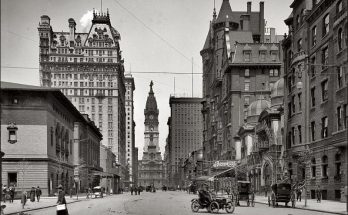
Meantime, as one result of the Haymarket tragedy, the Civic Federation was founded by Lyman C. Gage, a banker, to provide free and open discussion of controversial questions. In 1889 Jane Addams opened Hull House in the worst slum district on the West Side. By 1890 Chicago had more than 1,000,000 people, having added 200,000 the previous year by the annexation of several surrounding municipalities. The Newberry Library, and The Public Library, had been founded, and in 1892 the University of Chicago began with the most auspicious program in university history. Theodore Thomas had organized the Chicago Orchestral Association and had long been presenting the popular concert series that brought the city renown as a musical center. W. L. B. Jenny, Daniel H. Burnham, John W. Root, William Holabird, and other architects were constructing huge new buildings on steel frames and evolving a new architectural form. In Maitland Dictionary of American Slang, published in 1891, the new term “skyscraper” was defined as “a very tall building such as are now being built in Chicago.”

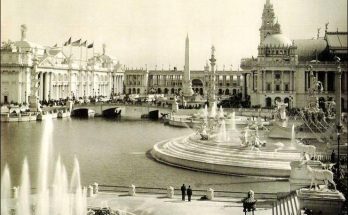
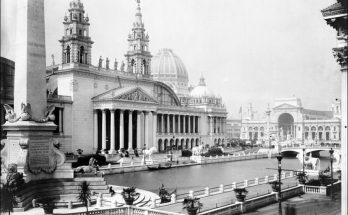
Commerce, manufacture, labor, and these new cultural developments united to bring the city one of its great triumphs, the World’s Columbian Exposition of 1893, in celebration of the 400th anniversary of the discovery of America. Jackson Park was developed out of swamp land on the South Side and here were built the great white buildings of the Fair in accordance with a master plan drawn by Daniel H. Burnham. The “White City,” as it was soon known on five continents, was hailed as the miracle of the day, the “miniature of an ideal city . . . built as a unit on a single architectural plan . . . a symbol of regeneration.” Millions crowded into the Fair to stare at and be equally impressed with “the most beautiful building since the Parthenon,” a knight on horseback made of California prunes, cannons by Krupp, the Tower of Light, and the Parliament of Religions–the whole providing “matter of study to fill 100 years.”

Chicago History 1800s

chicago river Chicago History 1800s

Social life was a melange of the “humbug and frippery of an eastern city” and backwoods crudities, of New England ideals of education and religion, and frontier ribaldry. Churches were established as soon as congregations could be formed. Including the newlyarrived Irish, German, and Scandinavian groups, who composed more than one-third of the population, there were 20 congregations, all but one in their own buildings and nearly all self-supporting. Methodism had the earliest start, in 1831. Catholics, Baptists, Presbyterians, formed congregations in 1833, followed the next year by Episcopalians, and by Universalists and Unitarians in 1836, Swedenborgians in 1842, and Jews in 1847. Private and semi-private schools preceded the first permanent establishment of free schools in 1841. Rush Medical College, initiated in 1837, soon had a city hospital.

Beginning in 1848, canal and railroad penetrating the fertile farmlands gushed torrents of city-building nourishment into Chicago. The city had quadrupled in size in its seven years of plenty, fed only by the comparatively trickling flow through its prairie roots, the crude wagon trails. The Illinois and Michigan Canal, opened in 1848, tapped the navigation head of the Illinois River 100 miles southwest and connected it with the Chicago River and Lake Michigan. This reversed the flow of grain and pork that had been draining southward to the Gulf of Mexico and thence to the eastern seaboard. Two years later, New Orleans, “once the emporium and mart of the immense empire of the west” began to decline in commercial rank. By 1860 Chicago’s grain receipts were nearly ten times as large as those of New Orleans. Lumber was brought down the lake by a fleet of 500 brigs, and carried into the treeless prairies by canal boat, supplying farms and towns as far as Fort Leavenworth, Kansas. Chicago became the largest lumber market in the world.

Total imports and exports quadrupled in the first year of the canal, which carried an increasing tonnage until the early eighties. But when rail replaced trail and striped the country with bands of steel, Chicago’s growth rocketed to dizzy heights. A stub running a few miles to the west in 1848, then the lines of the Illinois Central and the Rock Island, and the Michigan Southern from the east in 1852, were the first of the strands that were soon tied into a knot that gripped the Middle West to Chicago.

Lake Michigan, in its dual rôle as barrier and carrier, strengthened the hold. Interposing its 307 miles of deep water between East and West, like a huge lens, it focused to a point the railroad lines between the entire Northwest and the East. Chicago became the greatest railroad center in the world. For many years interchange of cargo between waterway and railway boomed both forms of transportation. In 1869 the 13,730 arrivals at the Chicago Harbor exceeded the combined number of vessels entered at the ports of New York, Philadelphia, Baltimore, Charleston, Mobile, and San Francisco.

Local merchants had vigorously opposed the building of railroads in Chicago, arguing that trade would be ruined if farmers did not drive their produce into town and there fill up their wagons with supplies to carry home; they soon saw the transformation of their city into a vast wholesale mart, supplying entire towns and cities. Chicago’s population increased six-fold between 1840 and 1850, rising from 4,470 to more than 28,000, and during the next decade vaulted to almost 100,000.

By 1856 the city embraced 18 square miles, and was trying desperately to pull itself out of the mud. Its streets had been little better than swamps–beloved by hogs, dogs, and small boys, but a terror to horses and pedestrians–and a serious menace to health, for the slops of the city were poured into these “noisome quagmires.” A few streets had been paved with planking as early as 1849, and five years later the city had 27 miles of such pavement. It represented a considerable improvement, but was not without its disadvantages: laid on marshy ground only a few feet above the water level of the river, the planks rotted quickly and snapped under the weight of straining horses, or even pedestrians, and the loose ends flew up to deliver them a stunning slap in the face. Sand and then cobblestones were laid, but were immediately swallowed by the ubiquitous mud. At last, with heroic resolve, Chicago decided to raise the level of its streets 12 feet, a herculean task undertaken in 1855. Sand was dredged from the river, which accomplished the double purpose of deepening the channel and providing fill not only for the streets but for 1,200 acres of low ground between them. The new streets were huge ramps that ran level with second-story windows until people either jacked up their houses or converted their original ground floors into cellars. For years the sidewalks climbed and dipped like roller coasters. In 1859 a mile of track for horse cars was laid on State Street, which soon replaced Lake Street as the business center. A few four-story brick buildings began to replace flimsy wooden structures in the downtown section, but the Chicago of 1860 was described in its day as “one of the shabbiest and most unattractive of cities . . . . Half the town was in process of elevation above the tadpole level and a considerable part on wheels –a moving house being about the only wheeled vehicle that could get around with any comfort to the passengers.”

Part of its shabbiness could be attributed to the depression that followed the panic of 1857, which struck the city a staggering blow. One-tenth of its 1,350 business establishments closed their doors; many thousands were thrown out of work to face starvation. In the midst of this distress Chicago built the Wigwam, a huge wooden shed, to accommodate the Republican National Convention, at which Lincoln was nominated for the presidency. Then came the Civil War to provide such stimulation of business as the always slightly feverish city had never known. To feed great armies in the field, farmers broke new ground and grain shipments from Chicago more than doubled in two years, rising to 65,400,000 bushels in 1862. In 1864 the milesquare Union Stock Yards were built. The McCormick and other factories were humming in their effort to satisfy the apparently insatiable demand for reapers, steel plows, agricultural implements of all kinds, harness, wagons, and a miscellany of wood and metal products.

In 1864 George Pullman built his first sleeping car, The Pioneer, marking the birth of another great local industry. Business transacted through the banks swelled to such a volume that the Chicago Clearing House was established in 1865. By 1870 Chicago’s population numbered some 300,000, a three-fold increase within a decade. It had now outstripped Cincinnati, an old rival, and was hot on the heels of St. Louis, with whoops of joy and taunts of derision, which were repaid in kind. Chicago had to reach greedily for trade in all directions in order “to support its fast horses, faster men, falling houses, and fallen women,” was the acid comment.

History of Chicago

chicago 1 History of Chicago

In September 1673, there were seven Frenchmen here, but only for a day–Louis Jolliet, Father Jacques Marquette and five canoemen–first white men known to have been at the site of Chicago. Returning to Mackinac after exploring the Mississippi as a possible route to the Pacific, they had ascended the Illinois and Des Plaines Rivers, portaged across a short swampy tract in the southwest section of the present city, and paddled down the South Branch and the Chicago River into Michigan. They had failed of their original quest, but they had discovered something quite as important–the Chicago portage, a principal key to the continent–and they immediately appreciated the value of their find. Jolliet envisaged a canal penetrating the heart of the immense expanse of New France, reporting that it would be necessary to dig through only “half a league of prairie,” to provide a continuous water route between the Great Lakes and the Mississippi Valley.

Curiously, no Indian settlement appears to have been made here until 1696 when Father Pinet, a Jesuit, established the Mission of the Guardian Angel and came periodically during the next four years to minister to the Miami, recent arrivals. The stream was known to the Indians as the Checagou, signifying anything big, strong, or powerful. But as the river was ever a small and sluggish stream, the “strong” probably referred to the pungent wild garlic that grew in profusion along its banks.

La Salle’s ambitious schemes to colonize the Illinois Valley failed; hostile Indians closed the Chicago portage for long periods. When possession of the entire region passed to the British in 1763, there remained in Chicago no permanent marks of the 90 years of French rule. Twenty years later the country became part of the infant American Republic, but actual control was exercised by the British and their redskin allies until they abandoned their posts following Jay’s Treaty, signed in 1794. The next year, by the Treaty of Greenville, the Indians ceded, among other territories, “a piece of Land Six Miles Square at the mouth of the Chicago River,” recognized by the military authorities as a strategic point from which to command the farther reaches of the Northwest Territory, but no attempt was made to occupy it for almost a decade.

At length, in 1803, Capt. John Whistler, grandfather of the famous painter, arrived with a company of infantry from Detroit to take possession. At the point of a narrow bend in the river, which then curved sharply southward from where the Michigan Avenue bridge now stands, Whistler and his men built log blockhouses, barracks, and stores, enclosed within a strong stockade, and named the fort for Henry Dearborn, veteran of the Revolutionary War, then Secretary of War in Jefferson’s Cabinet. Opposite the fort, on the north bank, stood four cabins; three were occupied by Frenchmen with their Indian or half-breed wives; the fourth, a large cabin of squared logs surrounded by numerous outbuildings, stood vacant. It had been erected about 1783 by Jean Baptiste Point Sable, an industrious and cultivated Negro of Santo Domingan origin, who had prospered in trading with the Indians and in outfitting occasional travelers using the portage, but who had suddenly vanished in 1800.

The Sable trading post was taken over in 1804 by John Kinzie, a Scotch-Canadian, the first English civilian settler, who in search of beaver pelts and shaved deerskins energetically extended his field of operation to the north and west. The settlement in the shadow of Fort Dearborn grew slowly until by 1812 it had a dozen or more small cabins sheltering some 40 persons–the Frenchmen and their families, the Kinzies, several farmers, a cattle dealer, and a few discharged soldiers with their families. The War of 1812 aroused uneasy fears in this isolated outpost, especially after the news came that the British and their Indian allies had easily captured Mackinac at the head of the lake in July 1812. General William Hull, commander of the American forces in the Northwest, reported to the Secretary of War that he was ordering the evacuation of Fort Dearborn, “provided it can be effected with a greater prospect of safety than to remain,” but this conditional proviso was omitted in the order (not in Hull’s handwriting) sent to Capt. Nathan Heald, Whistler’s successor at the fort.

Black Partridge, a friendly Potawatomi chief, argued against removal, saying that he had been warned of trouble by “linden birds,” but on the morning of August 15, 1812, the fort was evacuated, and the group, numbering approximately 100, started south along the beach on their way to Fort Wayne, led by an experienced scout, Captain William Wells. The nondescript column had not marched two miles when, with a whoop, a large band of Indians in their war paint came swarming down the dunes and fell upon the party, killing more than half–all of the dozen militiamen, twenty-six of the fifty-five regulars, two women, and most of the children. With the exception of the Kinzies, to whom the Indians were friendly, all survivors were taken and held captive until they were freed by ransom or death. The next day, the Potawatomi set fire to the fort in revenge for the many indignities the “Long Knives” had inflicted upon them in the past.

Four years elapsed before the fort was rebuilt. Kinzie and a few other survivors returned and some new settlers arrived. The growth of the powerful Astor’s American Fur Co. monopoly absorbed the individual traders and led, after lobbying in Congress, to the abolition of the government trading factory system in 1822. But the rapid decline of the fur trade in the depleted region had already set in. Although an election was held in 1826 to select state and national officers, Chicago remained a somnolent settlement of squatters, evincing more vigorous signs of life only when the State Canal Commissioners surveyed and started the sale of a few blocks on both sides of the river as the terminal site of the projected Illinois-Michigan Canal. The date of the filing of the survey plat, Aug. 4, 1830, is the first in Chicago’s corporate history. The following year Chicago was designated as the seat of Cook County.

The enormous mushroom growth of the modern city began in 1833, the year Chicago was incorporated as a town with a population of less than 200. The surrounding area had been cleared of Indians by the removal of the tribes following the Black Hawk War, and a harbor was opened by cutting through the sand-bar from the bend in the river to the lake. Glowing reports about the potential fruitfulness of northern Illinois and southern Wisconsin were eagerly received in the East–by farmers wearied of scratching the stony New England fields for an existence in competition with the more productive Ohio lands, discontented workers in the growing factories of New York and New England, and unsettled immigrants from western Europe in search of virgin soil on which to build new homes and an entire new life. The way was clear–the Erie Canal through the Mohawk pass to Buffalo, schooners and steamboats on the Lakes, and the harbor at Chicago.

Twenty thousand swept into Chicago from Buffalo in the first year ( 1833) of a wave that was years in passing. Many others came over eastern turnpikes. All but a few went on, in wagons, into the “plains without end.”

Realizing that Chicago’s marshy acres rested on economic bedrock, merchants early established the foundations for the vast trade to come. It was an era of wild speculation throughout the land-hungry country, but the fever raged nowhere more vehemently than in Chicago, climaxed in 1836 with the sale of lands along the projected Illinois and Michigan Canal. Harriet Martineau, in her Society in America, remarked amazement at finding in Chicago that “wild land on the banks of a canal, not yet even marked out” was selling for more than rich and improved lands “in the finest part of the valley of the Mohawk, on the banks of a canal which is already the medium of an almost inestimable amount of traffic.”

Incorporated as a city in 1837, Chicago suffered severely in the financial panic and deflation of that year, but on his arrival by steamboat the next summer, Joseph Jefferson, destined to become one of the great actors of his day, found Chicago in a typically buoyant mood: “Off we go ashore and walk through the busy little town, busy even then, people hurrying to and fro, frame buildings going up, board sidewalks going down, new hotels, new churches, new theaters, everything new. Saw and hammer–saw, saw, bang, bang–look out for the drays!–bright and muddy streets–gaudy-colored calicos–blue and red flannels and striped ticking hanging outside the dry-goods stores–bar-rooms–real-estate offices–attorneys-at-law–oceans of them!”

And he might have noted, but for his tender years, gamblers, horsethieves, holdup men, prostitutes, ruffians, and “rogues of every description, white, black, brown, and red,” the usual riffraff of a booming frontier town. To combat sin and discourage even innocent ribaldry, the more pious organized “seasons of prayer,” but with no appreciable effect.

It was the payment of eastern money for canal construction and harbor improvement that helped sustain the city until the flow of an agricultural surplus in 1841 from the rapidly developing surrounding region forced Chicago’s first rooted growth. From three States in a radius Of 250 miles, canvas-covered wagons, laden with wheat–200 a day by 1847–trundled prairie wealth into Chicago. Elevators rose along the river banks, holding grain until the spring arrival of dozens of steamboats and propellors “and an almost endless number of large brigs and schooners,” from Buffalo. Half a million bushels in the second year of surplus ( 1842), 25 times as much a dozen years later, and Chicago became the world’s largest grain market. Hogs and cattle were driven through prairie grass to Chicago abattoirs; barreled pork and beef reached markets as far as London.

In 1847 there were more than 450 stores, centering mainly about Lake and Clark Streets. Lumber yards, elevators, shipyards, warehouses, and factories lined the docks of the river jammed with sail and steam craft.

Industry in the main was handmaiden to the extractive economy of the period. Field and forest fed tannery and packing plant, flour and wood-work mill; fabrications of farm machine works and wagon factories helped to cultivate and garner. But a small surplus of manufactured goods produced by the more than 200 concerns began to find an eastern market.

Most of the 16,859 residents of 1847 lived in frame or “balloon” houses, painted white; successful business men built large houses, some of brick, in green squares on the North Side (now the Near North Side). Hotels and taverns housed hordes of travelers and unmarried residents and provided centers for town conviviality.