Holland

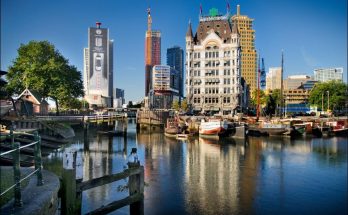
Vintage Rotterdam Holland Travel Poster Art Print

Rotterdam owes its ultra-modernity to its utter devastation in Second World War. The visible result of this ‘fresh start’ is one of the most dynamic and efficient seaports in the world. Sited on the estuaries of the Maas (Meuse) and the Rhine, the Europort of Rotterdam is one of the major European trade centers. There are frequent pleasure cruises through the heart of dockland and, for a panoramic view of the city, go to the top of the 392-foot Euromast. At street level you should not miss the Boymans-van Beuningen Museum which houses many of the works of Hieronymus Bosch, the medieval painter, whose bizarre masterpiece, The Garden of Delights, rests in the Prado in Madrid. Hotels in Rotterdam: Rotterdam Hilton (Weena 10); the Atlanta (Coolsingel 97 / Aert Von Ness 4); the Savoy (81 Hoogstraat) and the Rijn Hotel (Schouwburgaplein 1).

vintage holland Vintage Rotterdam Holland Travel Poster Art Print

Holland Via Hull-Rotterdam, LNER Poster, 1923-1947
Buy This Allposters.com

What to do in The Hague: Restaurants, Hotels, Maduodam

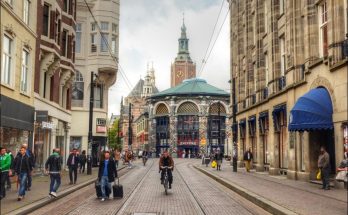
To avoid confusion, understand that the Dutch call it Den Haag, and they write it ‘s-Gravenhage. This is the seat of government (since 1247), the Diplomatic Corps and the International Court of Justice. For splendid pageantry be there on the third Tuesday in September when the Queen presides over the State Opening Parliament. On the June 15, The Hague tunes up for the world-famous Holland Festival of Music and Ballet. And, in adjoining town of Scheveningen, there is a festival of music and drama called the Kurhaus Season. The Hague is also home to the renowned Mauritshuis Collection, an assembly of Dutch Masters housed in a 17th century mansion. There is also an Aladdin’s Cave of Piet Mondriaan’s work at the Gemeente Museum.

Three tips for dining out in the Hague. First, the Royal Restaurant (Lange Voorhout 44), undeniably expensive but the French food is exquisite. Formality is the keynote here. ‘t Gemeste Schaap (Raamstraat 9) is a moderately pricey, but the food is good and traditional Dutch ambiance make it well worth a visit. Also at The Hague is the Bali Restaurant (Badhuisweg 1, Scheviningen) opposite the Kurhaus Hotel. The Rijjsttafel at the Bali is reputed to be the finest in Holland.

Hotels in The Hague: Promenade (van Stolkweg 1), the Park Hotel (Molenstraat 53) and are Des Indes (Lange Voorhout 56) and Grand Hotel Terminus (180 Stationweg).

One of the Holland’s most famous attractions can be found not far from the Hague; the miniature village of Maduradam. In this extraordinary 1:25 scale model of a Dutch town trains run, the bands play and at night the city lights up just like real. If you have ever wondered how Gulliver really felt, do not miss Maduodam.

Hague What to do in The Hague: Restaurants, Hotels, Maduodam

Busy Street at the Hague Netherlands
Buy This Allposters.com

Migration to Netherlands

asian girl at central station amsterdam Migration to Netherlands

Asian Girl with Laptop at Central Station, Amsterdam, Holland Photographic Print
Su, Keren
9 in. x 12 in.
Buy at AllPosters.com
Framed   Mounted

Migration has become one of the great challenges worldwide. This is due to the increasing numbers of migrants in all parts in the world, though migration is by no means a new phenomenon. Nevertheless, Castles and Miller (1993) call this era the ‘age of migration’. The challenges posed by migration affect many fields, from politics to education, with different answers found in different countries and under different circumstances.

It will be stressed that integration is one of the key words in the political as well as in the educational discourse in most countries of immigration. Yet, even if integration is a common response in most European and classical countries of immigration, its meaning can still differ since this common approach does not neglect the fact that there are also differences between these countries due to their varying national and cultural developments. There have been periods in world history as well as in European history where mass emigration was part of daily life – generally amongst the poorest social classes of a country. In Europe, the Irish emigration during the great famine is an example as well as emigration from Germany during and after the Industrial Revolution in the nineteenth century.

In European history, there has, however, not only been work migration or migration due to poor economic conditions, but also migration due to political or religious persecution, e.g. the emigration of the Huguenots from France into Prussia. This example also illuminates the pull-and-push effects of migration, since Prussia was very much interested in the migrants because of their craftsmanship. We also find examples of work and settler immigration that were welcomed by the countries of immigration, such as migration into Russia at the time of Empress Catherine the Great. Here, the pull effect is stronger than the push effect. While migration is no new theme to mankind, neither worldwide nor in Europe, we find new developments in the ways in which migration challenges societies today. Migration has become part of the daily life of many, if not most people in Europe since migrants are present in most neighbourhoods or work places.

Migrants and their families have also become a topic in the media – though often with negative connotations. This contributes to the fact that most people are aware of migration, migrants, and especially of the changes in their societies due to migration. These changes are experienced in different – positive and negative – ways. While the richer variety of cuisine is generally well accepted, a shortage in housing, which is thought to be a result of migration, is not. Migration has also become an option for more people in European countries and this holds true especially for the middle classes. This kind of migration is often due to studies or work in another country for a limited time and is therefore not always regarded as migration. Thus, emigration is nowadays less reflected on than immigration. Furthermore, immigration is often discussed critically due to its impact on the labour markets, the socio-economic structure and on the educational system of the receiving country.

Migration to European Countries

Although migration is no new phenomenon in Europe, it has challenged European nation states since the post-war period in many aspects despite differences amongst states as to when it took place, the migration groups themselves and the political reactions to it. This is also applicable to a certain extent to the classical countries of immigration, as, for example, when Australia was in urgent need of new immigrants after the Second World War and the experience of being in danger of foreign occupation. Worldwide, countries of development have experienced immigration as well as emigration due to natural catastrophes and wars of different kinds such as civil wars or wars of liberation. The European development is of special interest as these migration processes fall in the time of the growth of European unity.

Nation states throughout the world are trying to determine whether they will perceive themselves as multicultural and allow immigrants to experience multicultural citizenship (Kymlicka 1995) or continue to embrace an assimilationist ideology. In nation states that embrace Kymlicka’s idea of multicultural citizenship, immigrant and minority groups can retain important aspects of their languages and cultures as well as have full citizenship rights. Nation states in various parts of the world have responded to the citizenship and cultural rights of immigrant and minority groups in significantly different ways.

Since the ethnic revitalization movements of the 1960s and 1970s, many of the national leaders and citizens in the United States, Canada and Australia have viewed these nation states as multicultural democracies (Banks and Lynch 1986). An ideal exists within these nation states that minority groups can maintain important elements of their community cultures and become full citizens of the nation state. However, there is a wide gap between the ideals within these nation states and the experiences of ethnic groups. Ethnic minority groups in the United States, Canada and Australia experience discrimination in both the schools and in the wider society.

Other nation states, such as Japan and Germany, have been reluctant to view themselves as multicultural societies. Citizenship has been closely linked to biological heritage and characteristics in these nation states. Although the biological conception of citizenship in both Japan and Germany has eroded within the last decade, it left a tenacious legacy in both nation states.

Since the 1960s and 1970s, the French have dealt with immigrant groups in ways distinct from the immigrant nations of the United States, Canada and Australia. In France the explicit goal is assimilation (now called integration) and inclusion (Castles 2004). Immigrant groups can become full citizens in France but the price is cultural assimilation. Immigrants are required to surrender their languages and cultures in order to become full citizens.

The academic achievement gap between ethnic minority and majority group students is another salient issue. African-Caribbean, Pakistani, and Bangladeshi students in Britain and Turkish students in Germany are not achieving on a level equal to that of the majority groups in their nation states. There is also a significant achievement gap between African-American students and White students in the United States (Banks and Banks 2004). However, the underachievement of minority students is a complex issue worldwide that defies facile solutions and responses.

Throughout his career the anthropologist John U. Ogbu (Gibson and Ogbu 1991) tried to uncover some of the complex issues related to the differential achievement of ethnic minority groups in various nations. He believed that researchers needed to identify the important difference among ethnic minority groups in order to understand why some were highly successful academically and others were not. His classification of ethnic groups into three types (autonomous, immigrant or voluntary, and castelike or involuntary) provides a useful way to conceptualize differences among ethnic groups. However, it can lead to harmful generalizations about the characteristics of specific groups and divert attention from structural factors that cause minority underachievement. The issue of minority underachievement is undertheorized and requires more complex and nuanced explanations and theories than those that currently exist.

Global migration has increased the number of languages within the nation states and schools in Europe as it has within the United States, Canada, Australia and Japan. One of the most significant issues discussed in this book is the increasing language diversity in European nation states and how schools in various nations are responding to it. Constructing a thoughtful and equitable national language policy related to the languages of immigrant and ethnic groups is a complex and divisive issue in European nation states as it is in other nations throughout the world.

Source: Migration, Education and Change.

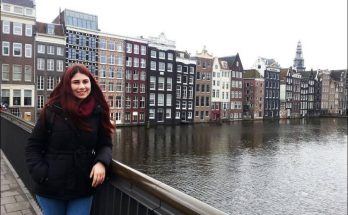
Amsterdam: A Quick Orientation

Amsterdam, in its physical aspect, is almost entirely a product of the so-called “Golden Age” of the Netherlands-that period in the 17th century when Holland surged to the near-pinnacle of world power, after its victory over Spain in the brutal Eighty Years War. It was during this period that the merchants of Amsterdam-then the dominant element in the city-laid out a pattern of gently-curving, concentric canals that occupy the central section of Amsterdam and constitute the city’s particular glory today. Amsterdam performs an essentially capital city service function for the rest of the Dutch economy.

prinsengracht and wsterkerk amsterdam Amsterdam: A Quick Orientation

Prinsengracht and Wsterkerk, Amsterdam, Holland Photographic Print
Arnold, Jon
16 in. x 12 in.
Buy at AllPosters.com
Framed   Mounted

The canals run in a fairly regular pattern that makes it quite easy to orient yourself. Starting at the Central Station, the first of the canals is the Singel. Then comes the Herengracht (“Gentlemen’s Canal”), then the Keizersgracht (“Emperor’s Canal”), and finally the Prinsengracht (“Prince’s Canal”). Along these canals the merchants of 17th-century Amsterdam then constructed what seem today like endless lines of gilded, patrician mansions and homes. These have, in recent years, been occupied by business firms, but their façades are absolutely untouched-and it is in this most beautiful centuries-old setting that you’ll want to spend most of your time in Amsterdam.

Crossing through this pattern of parallel, concentric canals, like the spokes of a wheel, are avenues, the most important of which is the Damrak, which starts at the Central Station and heads straight to the Dam Square, site of the Royal Palace, the Nieuwe Kerk (New Church), and National Monument. From the Dam Square, this street becomes the Rokin, and veers a bit as it heads to the Mint Square (Muntplein), where the famous old Mint Tower Amsterdam stands, and where the Amstel River begins.

Near the Mint Square is the Rembrandtsplein (Rembrandt’s Square), one of the two major entertainment areas of Amsterdam; a bit further out, and to the west, is the Leidseplein (Leidse Square), the other entertainment section of Amsterdam, and the site of the Stadsschouw-burg (Municipal Theatre). And beyond this central area is a slightly more modern section where you’ll find the two great art museums of Amsterdam-the renowned Rijksmuseum and Stedelijk Museum- as well as the famous home of its much-acclaimed orchestra, the Concertgebouw.

Chicago’s History 1800s

chicago 1930s Chicago’s History 1800s

Times were indeed lush at the tip of the lake. Typical of the almost Hollywoodian order of things in that period was the case of the bankrupt backwoods tailor who came to Chicago, sold trousers for a few years, and built one of the largest and most celebrated hostelries of its day. Race tracks, gambling saloons, and bawdy houses multiplied. Lavish “marble” mansions went up along Michigan Avenue to 12th Street. Theaters, hotels, shops, and business buildings crowded into what is now the Loop. Coal yards, warehouses, flour mills, factories, foundries, and distilleries lined the river banks and the lake front. Scattered through the city were 170 churches–25 Catholic, 21 Methodist, 19 Presbyterian, and 5 Jewish, a partial reflection of the fact that half the Chicagoans of that day were foreign-born.

In 1867, after years of violent protest that the entire community was being poisoned by “filthy slush, miscalled water . . . a nauseous chowder” of fish and filth, which was taken from the lake into which the city poured its sewage, a sanitary water system was installed and immediately reduced the appallingly high death rate. The flow of “Garlic Creek” was reversed in 1871, and some of its foul waters were carried down the Illinois into the Mississippi, but not in sufficient quantity, so that sewage continued to pour into the river and the lake, to be thrown back at Chicago by the winds and waves.

Public high schools and evening schools, industrial and professional schools, including one of the first art schools in the country, two colleges, three theological seminaries, the Chicago Historical Society, and the Academy of Sciences were established in this period. In 1869 a ring of unimproved parks with boulevard connections surrounded the “Garden City.” Beyond, in suburban subdivisions, carpenters were hammering out miles of houses that were to be swallowed in the city’s growth within two decades. “More astonishing than the wildest vision of the most vagrant imagination!” visitors exclaimed, and Chicagoans agreed, although they felt that a more accurate index of the city’s superiority over all others was provided when the White Stockings, its professional baseball team, defeated the Memphis nine, 157 to 1.

But, born in the haste to put wall and roof around home and business as quickly and cheaply as possible, a large part of the city’s construction ran to “shams and shingles.” Of the estimated 40,000 Chicago buildings in 1868, more than seven-eights were wooden. In 1871 the total increased 50 per cent, and while the 40 new stone buildings on State Street and many brick and iron-front structures elsewhere were promising improvements, solid blocks knew nothing but flimsy pine.

After months of severe drought a fire of unknown origin started in such a block, in a cow barn behind the cottage of Patrick O’Leary on DeKoven Street, Sunday night, October 8th, 1871. It soon spread beyond the control of the firemen, who were wearied by fighting and celebrating the defeat of a blaze that burned four blocks the previous day. A powerful wind swept flames to the north and northeast and hurled brands in advance of the roaring columns of fire, which destroyed the notorious “Conley’s Patch” and practically everything north of Van Buren Street in the areas now designated as the Downtown District and the Near North Side. So intense were the flames that hot blasts were felt in Holland, Michigan, 100 miles across the lake. Tapering to a point near the lake at Fullerton Avenue, the boundary with the then suburban Lake View, the fire stopped after consuming 17,450 buildings in 27 hours. At least 250 persons perished. Homes of one-third the population, about 1,600 stores, 60 manufacturing establishments and 28 hotels, railroad structures, government and other public buildings, and bridges became three and one-third square miles of ashes and debris. Thousands were penniless, stripped of their last possession.

The embers were scarcely cool before rebuilding began. Generous contributions of money and supplies came from the entire country and from Europe. Thousands of temporary structures provided for immediate needs while more than 100,000 artisans were reconstructing the city under stricter construction codes, although the latter were frequently violated. Extensions of credit and payment of about half of the $88,634,022 insurance on the $192,000,000 loss helped rebuild the business district within a year. In another two, scarcely a scar of the fire remained anywhere. Many buildings, particularly hotels and depots, were replaced by far costlier structures. Fashion took over Michigan Avenue south of 12th Street, and Prairie Avenue, and brought in granite and brownstone. Chicago dumped its debris within the lake breakwater, forming subsoil for a future park, and went about its increasing business. Local manufactures doubled between 1870 and 1873; Chicago banks, alone of those in the larger cities, continued steadily to pay out current funds during the acute financial panic of 1873.

The germ of American industrialism found the Chicago of the middle seventies an ideal medium. A circle of 500 miles contained the principal ingredients. Around western Lake Superior lay one-fifth of the world’s richest iron-ore reserve, yielding at the slightest scratch, easily loaded on lake freighters after a short land haul, and carried away by the most economical form of transportation on the continent. In Illinois, Indiana, Kentucky, West Virginia, and Pennsylvania, Chicago’s railroads clutched at a trillion tons of coal. Blast furnaces and large factories forged tremendous wealth that filled Prairie Avenue and spread into Lake Shore Drive.

Nationwide labor unrest, following the wave of western settlement that had “broken against the and plains” became particularly acute here. The line between wealth and poverty, cutting sharply into a single generation of workmen with rapidity unequalled elsewhere, drew Chicago into the forefront of “radical” cities. In 1877, led by Albert R. Parsons, workers in the factories and on the railroads struck for increased wages and the 8-hour day. Federal troops broke the strike, but without removing the causes of discontent. Industrial warfare over wages and hours grew increasingly bitter and culminated in the Haymarket bombing of 1886. Although no adequate evidence was produced that they had thrown the bomb, Parsons and three other labor leaders were hanged for the crime. Two others escaped death by having their sentences commuted to life imprisonment, and a third received a sentence of 15 years in prison. These three were pardoned seven years later by Governor John P. Altgeld, “. . . eagle forgotten” in Vachel Lindsay’s phrase, who denounced the trials as unfair and illegal and was himself denounced as little better than a criminal for daring to doubt highly questionable evidence. Again large strikes broke out in the depression years that followed 1893, notably that which began in the local Pullman shops and spread to the railroads; once more Federal troops broke the strike.

Meantime, as one result of the Haymarket tragedy, the Civic Federation was founded by Lyman C. Gage, a banker, to provide free and open discussion of controversial questions. In 1889 Jane Addams opened Hull House in the worst slum district on the West Side. By 1890 Chicago had more than 1,000,000 people, having added 200,000 the previous year by the annexation of several surrounding municipalities. The Newberry Library, and The Public Library, had been founded, and in 1892 the University of Chicago began with the most auspicious program in university history. Theodore Thomas had organized the Chicago Orchestral Association and had long been presenting the popular concert series that brought the city renown as a musical center. W. L. B. Jenny, Daniel H. Burnham, John W. Root, William Holabird, and other architects were constructing huge new buildings on steel frames and evolving a new architectural form. In Maitland Dictionary of American Slang, published in 1891, the new term “skyscraper” was defined as “a very tall building such as are now being built in Chicago.”

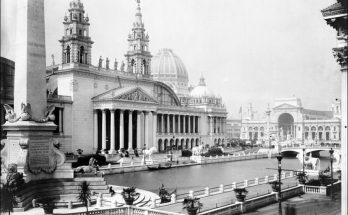
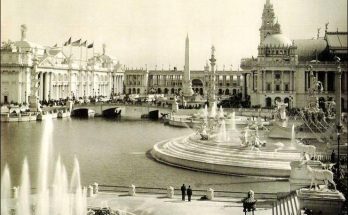
Commerce, manufacture, labor, and these new cultural developments united to bring the city one of its great triumphs, the World’s Columbian Exposition of 1893, in celebration of the 400th anniversary of the discovery of America. Jackson Park was developed out of swamp land on the South Side and here were built the great white buildings of the Fair in accordance with a master plan drawn by Daniel H. Burnham. The “White City,” as it was soon known on five continents, was hailed as the miracle of the day, the “miniature of an ideal city . . . built as a unit on a single architectural plan . . . a symbol of regeneration.” Millions crowded into the Fair to stare at and be equally impressed with “the most beautiful building since the Parthenon,” a knight on horseback made of California prunes, cannons by Krupp, the Tower of Light, and the Parliament of Religions–the whole providing “matter of study to fill 100 years.”