Illinois

First existing records of white men in Illinois

The first existing records of white men in Illinois were made by Father Jacques Marquette. On May 17, 1673, he and Louis Jolliet, with five voyageurs, left Mackinac, paddled over parts of Lakes Huron and Michigan into Green Bay, thence up the Fox River, crossed at the portage, and went down the Wisconsin.

On June 17 they entered the Mississippi. On the west side of the river, in what is now Iowa, they encountered and exchanged friendly greetings with the Kaskaskia tribe of Illinois Indians. The adventurers passed the mouth of the Missouri, saw the famous Piasa or Thunder Bird painted on the cliffs near the present city of Alton, and reached the mouths of the Ohio and Arkansas Rivers. There, having determined that the Mississippi flowed not into some western ocean, but into the Gulf of Mexico, and fearing Spaniards and hostile Indians, the Marquette party turned back late in July 1673.

Sitting Bison stamp
Sitting Bison by made_in_atlantis
Make custom postage with Zazzle.com

They returned by way of the Illinois River, which Marquette described in his Journal: “We have seen nothing like this river for the fertility of the land, its prairies, woods, wild cattle, stag, deer, ducks, parrots, and even beaver.” And Jolliet later reported that the valley was “the most beautiful and most suitable for settlement.”

Near Starved Rock they encountered the same tribe of Kaskaskia, now returned to their ancestral village site (about nine miles below the town of Ottawa), and their friendliness so won Father Marquette that he promised to return and set up a mission among them. From the Desplaines River they took the ancient portage trail to the Chicago River, thence to Lake Michigan, and up to Green Bay. Here Marquette, ill from the hardships of the voyage, was left behind, and Jolliet went on alone to Montreal where, almost in sight of the town, his canoe overturned and his carefully kept Journal was lost. Nevertheless he gave enthusiastic verbal descriptions of the new country, of its fertility, and ease of cultivation; he spoke of its marvelous transportation facilities, and showed how, with a canal built through “but half a league of prairie,” a boat could sail from Lake Erie down the Mississippi to the Gulf of Mexico.

On October 25, 1674, with two voyageurs as companions, Father Marquette set out from Green Bay to keep his promise to the Kaskaskia. The voyage proved a hard one, and not until December 4 did the party reach the mouth of the Chicago River. Because of the severe cold and the recurrence of his old illness, Marquette stopped “two leagues” above the mouth of the river for the winter. With the spring his strength returned, and in Easter week, 1675, he established the first mission in the Illinois country at the Great Village of the Illinois, calling it the Mission of the Immaculate Conception of the Blessed Virgin. But then, weakened again by illness, he decided to return to St. Ignace (Mackinac). He was canoed up the eastern shore of Lake Michigan by his two faithful companions; finally, when he was unable to go farther, they landed near the river named for him in the present State of Michigan. There, on May 18, 1675, he died.

Robert René Cavelier, Sieur de La Salle, the French explorer, came later to the Illinois country. In 1679, after the sinking of his Griffon on Lake Erie, he erected a fort at the mouth of the St. Joseph River, ascended that river, portaged to the Kankakee, and canoed up the Illinois River to Lake Peoria, where he made friends with the Peoria tribe of the Illinois. About two miles below the lake, on the south side of the river, he built Fort Crèvecoeur in January 1680. In his absence the men mutinied and plundered the fort, and raiding Iroquois burned the Peoria village. Upon his return to the Illinois Country in 1682, La Salle, with Tonti, built Fort St. Louis at Starved Rock as a key to the vast empire of forts and commerce he had conceived. But his enemies at court prevailed, and he was soon recalled. Returning to France, he received permission from the king to establish a colony at the mouth of the Mississippi; on March 20, 1687, on a branch of the Trinity River, he was shot from ambush.

Tonti, La Salle’s lieutenant, obtained in 1690 the privileges previously granted La Salle. In 1691-92 he moved Fort St. Louis from Starved Rock to Pimitoui, on Peoria Lake. For ten years he devoted himself to bringing in settlers, missionaries, and trade supplies. When he died in 1704, a chain of forts stretched from Montreal to Mobile. Tonti had at last succeeded where his chief, La Salle, had failed.

The Mission of the Holy Family was established at Cahokia in 1699 by priests of the Seminary of Foreign Missions. In 1703 the Jesuits moved the Mission of the Immaculate Conception to the Indian village of Kaskaskia, sixty miles below Cahokia, a short distance from the mouth of the Kaskaskia River. These two towns on the American Bottom, Cahokia and Kaskaskia, soon became the centers of French life in the Illinois country. In 1720, after the collapse of the Mississippi Bubble, the commandant of the Illinois country completed Fort de Chartres, 17 miles north of Kaskaskia. The name Illinois was first officially used when the seventh civil and military district of the French province of Louisiana was so designated.

Meanwhile British colonists were advancing on French territory. New York fur traders reached the Great Lakes by way of the Mohawk Valley; Carolina frontiersmen pushed around the southern end of the Appalachians into the lower Mississippi Valley; the English continued their Hudson Bay fur trade. Land speculation grew among the English colonists.

In 1747 the Ohio Land Company was organized, and in 1749 was granted 200,000 acres of land near the forks of the Ohio on condition that the territory be fortified and a hundred families settled on the land within seven years. Thus began the struggle which, at the end of the French and Indian War, found England in possession of all French territory on the North American continent.

The English occupation of the Illinois country did not begin at once. Pontiac, chief of the Ottawa, rose against the British in 1763, and captured all but three of the newly acquired forts in the Lakes Region. He was not defeated until the following year, and it was not until October 10, 1765, that the French flag was lowered and the British raised at Fort de Chartres. Here, on December 6, 1768, was held the first court under English jurisdiction in the Illinois country.

By this time the British colonists were moving into the land beyond the Alleghenies. Speculators in Virginia, Connecticut, and New York were organizing colonies, and colonial firms engaged in extensive trading operations. But few if any American settlers were attracted to Illinois, and the British showed no capacity for dealing with the French inhabitants. Chaos prevailed, and the population diminished.

Thus there was widespread sympathy in Illinois for the Colonial cause in the American Revolution. In 1776-77 powder purchased from the French and Spaniards was run up the Mississippi and Ohio Rivers from New Orleans to Wheeling, West Virginia. As the war progressed, the strategic position of the Illinois country as a link with Spanish and French allies, and as a base for attack on the British at Detroit, became apparent.

The task of winning this country was undertaken by George Rogers Clark in 1778. Authorized by the Governor of Virginia, he floated down the Ohio River with a band of 175 men. From Fort Massac he set out overland for Kaskaskia. On July 4, 1778, while Rocheblave, the expatriate Frenchman in command for the British, was penning another of his whining letters to England, Clark entered the village, and was greeted warmly by the inhabitants. Father Gibault, at Clark’s request, traveled to Vincennes, won the allegiance of the people there, and persuaded them to sign the Oath of Vincennes. Hearing of Clark’s successes, the Virginia Assembly decreed on December 9, 1778, that Illinois was to be a county of Virginia. But six days later Vincennes was lost to the British under the command of Governor Hamilton of Detroit.

Seeing the entire territory threatened, Clark set out for Vincennes with 170 men. It was February; the rivers and bottom-lands were flooded; for miles the men waded in water up to their waists on one of the most courageous marches in American history. At Vincennes Clark succeeded in detaching the townspeople from the garrison, and on February 25, 1779, Hamilton capitulated. Later that year Clark planned a campaign against the British at Detroit, but it was not carried out. The next year, when the British attacked the Illinois towns, Clark came to the aid of Cahokia and helped beat them off. As the war drew to a close, military operations ceased except for periodic Indian raids at the instigation of the British.

To organize the vast territory which Clark’s conquest had secured for the United States, the Ordinance of 1787 was passed. It created the Northwest Territory as a Federal territory to consist of the present States of Illinois, Indiana, Michigan, Ohio, and Wisconsin; slavery here was prohibited, except as a punishment for crime; a territorial government with limited suffrage was set up; provision was made that any area with sixty thousand persons could organize as a State and apply for admission to the Union.

Despite the Treaty of Paris in 1783, trouble with the British and their Indian allies continued. In 1794 American forces defeated the Indians at the Battle of Fallen Timbers, and by the Treaty of Greenville of the next year the Indians ceded small tracts of land at every important post and portage throughout the territory, including the site of the future Fort Dearborn, one at Peoria, and another at the mouth of the Illinois River. The United States then adopted an Indian policy which by 1809 had obtained from the Indians practically all of Ohio, eastern Michigan, southern Indiana, and most of western and southern Illinois.

Against this growing threat of the white man rose Tecumseh, and his brother, the Shawnee Prophet. They organized the Indians of the Northwest Territory, ordered white men barred from Indian villages, and forbade the selling of any more land to them. The Battle of Tippecanoe in November 1811, though a victory for the whites, had deterred Tecumseh little, and the Indians in the conspiracy remained active throughout the War of 1812, aiding the British in gaining possession of most of the Northwest Territory. Detroit was captured; the garrison and inhabitants of Fort Dearborn were massacred by the Indians a few miles from the fort as they attempted to flee on August 15, 1812. The end of the war brought the Northwest Territory back to the American republic, but the problem of the Indians continued down to the Black Hawk War of 1832.

Illinois remained part of the Northwest Territory until 1800. In that year, by an Act of Congress approved May 7 but not effective until July 4, 1801, it became part of Indiana Territory. In 1809, by an Act approved February 3, the Territory of Illinois was created, which included within its bounds the present State of Wisconsin. Illinois became a territory of the second class on May 21, 1812; during all of this territorial period Illinois was governed by Ninian Edwards. Finally, on December 3, 1818, shorn of the Wisconsin Territory, it was admitted as a State of the Union, although its population was only 40,258, far short of the 60,000 stipulated by the Ordinance of 1787.

A State constitution was ratified without being submitted to the people, and Shadrach Bond, elected without opposition, became the first State governor of Illinois. The first capital was Kaskaskia; two years later Vandalia succeeded it. Through the efforts of Nathaniel Pope, territorial delegate from Illinois, the northern boundary of the State, fixed by the Ordinance of 1787 at an east-west line placed at the tip of Lake Michigan, was moved 51 miles north, to a line along the longitude 42° 30′, and as a result Illinois obtained a shoreline on the Great Lakes. The reason given was that “additional security for the perpetuation of the union” would be afforded if Illinois were identified with the northern States. Today this added territory contains 55 per cent of the population of the State.

Illinois: The railroads had a revolutionary effect on the life of the State

Illinois: The railroads had a revolutionary effect on the life of the StateIllinois entered the transition stage during which Chicago developed from a mud-rutted town of 29,963 in 1850 to a city of 296,977 in 1870, probably the swiftest growth of a metropolis in history. The State boasted ten incorporated cities in 1850: Chicago, Alton, Springfield, Beardstown, Pekin, Quincy, Peoria, Bloomington, Galena, and Rock Island. Their difficulties were many: houses were scarce, rents high, the streets so bad they became quagmires in rainy weather; according to a contemporary newspaper, the gutters were filled with “manure’ discarded clothing, and all kinds of trash, threatening the public health with their noxious fluvia.”

One of the issues of the day was the hog nuisance; the streets, squares, and parks were public hog-pens. “Urbana had a record of more hogs in the community than people, and the porker had an equal right with the citizens to the streets.” Nor were there public utilities until the middle fifties, when the more progressive communities began to install water systems and gas for street lighting.

Twenty years after the rush to the lead mines at Galena in the late 1820′s, at which time a group of tent-cities containing more than 10,000 people had sprung up, the gold rush to California swept through Illinois. In 1849 more than 15,000 men and boys left the State for the western fields. The exodus subsided in 1850 as a result of discouraging letters and editorial warnings, but in 1852, with new stories of gold discoveries, the rush was revived. With the opening of the fertile lands of Kansas and Nebraska to settlement in 1854, still another migration took place. In the gold rush to Pike’s Peak in 1859, additional thousands left the State. The whole of the fifties was characterized by this draining of Illinoisans to the West.

In their place came new families from the East and South. In 1849 there appeared in the Boston Post a poem which began:

Westward the of Empire Moves:

Come leave the fields of childhood,
Worn out by long employ,
And travel west and settle
In the State of Illinois.

The Yankees settled in the northern area, the Southerners in the “Egypt” delta and the southern region. The sharp division of Illinois into “upstate” and “downstate,” reflected in habits, politics, and culture, persisted for years.

In even greater numbers immigrants arrived from Europe. French Icarians under Cabet set up a communistic colony at Nauvoo, the old Mormon city, in 1849. Portugese came to Springfield and Jacksonville; Scandinavians to Chicago, Rockford, Galesburg, Victoria, Andover, and Moline. The Bishop Hill colony was settled by Swedish Janssonists in 1846. But by far the most numerous were the Germans, fleeing their country after the defeat of their Revolution in 1848, and the Irish, driven out by potato famines and British oppression. By 1860 there were 130,804 Germans in Illinois, living chiefly in Chicago, Belleville, Galena, Quincy, Alton, Peoria, and Peru, perpetuating their rich culture in music societies, literary clubs, and Turnvereine. Many of the Irish were brought to Illinois to work on the canals and the railroads under the infamous system of contract labor; herded like cattle from Boston, New York, and Philadelphia to further Illinois internal improvements, they found, not the promised land of newspaper advertisements, but bad housing, improper diet, and unsanitary conditions, which took a large toll in illness and death.

Nowhere in the United States did the railroad fever of the fifties rage more than in Illinois. Farms were mortgaged, counties and municipalities subscribed to stock, Eastern capitalists poured millions into the enterprises. Many of the politicians in the State, from Governor French and Senator Douglas to township officials, speculated in land and railroad stock, and became wealthy. Charges and countercharges of corruption were hurled; the Illinois State Register declared in 1853 that the railroad bills “were prepared in New York and first canvassed by Wall Street men before they were sent to Springfield to secure legislative endorsement.” Senator Douglas persuaded Congress to grant 2,707,200 acres of land, scattered over 47 counties, for the long-awaited Illinois Central Railroad, and in 1851 articles of incorporation were granted by the legislature to a group of Eastern financiers, headed by Robert Rantoul of Massachusetts, on condition that the State be paid 7 per cent of the gross receipts annually. In September 1856 the railroad was completed. Seven other roads were constructed in this period, and one, the Galena and Chicago, was able to pay dividends of 20 per cent after the first year of operation.

The railroads had a revolutionary effect on the life of the State. Most of the early settlements had been near rivers. Now the rich fertile prairie lands of the vast interior were opened to farming and mining, to become soon one of the greatest corn-producing and coalmining areas in the world. The coming of the railroads brought a wave of prosperity; by 1860 farm values had risen 50 per cent over those of 1850; farm and city, raw materials and markets, were brought together. Towns sprang miraculously out of the prairies. Communities off the railroads faded away.

In the struggle that split the Union and led to the Civil War, Illinois furnished the two opposing national leaders, Stephen A. Douglas and Abraham Lincoln. The State itself was soon as divided as the Nation. As early as 1796 and again in 1802, memorials from the Illinois country had been addressed to Congress asking for repeal of the prohibition against slavery in the Ordinance of 1787. In 1824 a movement to amend the State constitution to allow the introduction of slavery was defeated. The kidnapping of free Negro residents in the State was countenanced for two generations, and the “black laws” of 1819 were still in effect. In 1837 the State legislature, excited by the spread of Garrison’s abolitionism, passed a resolution excluding abolition papers from the State and making the circulation of abolition petitions to Congress illegal.

In the same year, November 8, the valiant abolitionist newspaper editor of the Alton Observer, Elijah P. Lovejoy, while defending his fourth press from destruction by Alton mobs, was shot dead. Lovejoy’s fight was continued by such men as Benjamin Lundy and his Genius of Universal Emancipation at Hennepin. Antislavery societies grew. In 1840 the Liberty Party was formed in Illinois, and by 1846 it had gained a majority in 13 northern counties.

Yet in 1853 an act drawn by John A. Logan providing that free Negroes who entered the State could be sold into servitude was passed by the legislature. This bill aroused the anger of Democrats and Whigs alike. Even so, the Democrats might have maintained their power in the State if Douglas had not in 1854 sponsored the Kansas-Nebraska bill enabling settlers in the new territories to choose between free soil and slavery, with an amendment thereto repealing the Missouri Compromise of 1820 which had prohibited slavery forever in the Louisiana purchase above the line of 36° 30′.

From the opposition to this bill, in the form of a coalition of disapproving Democrats, Whigs, and Free Soilers, came the germ of the Republican Party in Illinois. After a mass meeting in Rockford on March 18, 1854, and another at Ottawa on August 1, a State Republican convention was held in Springfield on October 4 and 5. In the elections of 1854 the State was almost equally divided; the northern or Yankee half voted solidly anti-Nebraska, while the southern or downstate half voted with the solid South. Looking now toward the national elections, the Republican Party of Illinois was organized at a convention in Bloomington, May 29, 1856, with some leaders in the Democratic Party of the State taking active parts. The first Republican governor, William H. Bissell, was elected that year.

The Dred Scott decision hastened the coming of the Civil War. When the United States Supreme Court in 1857, held that the Missouri Compromise was unconstitutional, and that Congress had no power to pass a law forbidding a master from carrying slaves into the territories, it posed a serious question. Could slavery be excluded from the territories by any means? Douglas contended that it could, because the people could withhold the protective local legislation essential to its existence. Yet even this doctrine had its faults, for soon he found himself at odds with President Buchanan and the slavery Democrats over popular sovereignty as manifested in the case of Kansas, then seeking admission to the Union. At the same time Douglas was losing ground. The senatorial contest in 1858 between Lincoln and Douglas was fought on the issue of free soil or popular sovereignty.

On the evening of his nomination for the senatorship by the Republican convention, at Springfield, Lincoln declared: “A house divided against itself cannot stand. I believe this government cannot endure permanently, half slave and half free.” Forecasting another decision like that in the Dred Scott case, but applying to the States as well as territories, he said, “Such a decision is all that slavery now lacks of being alike lawful in all the states.” The famous LincolnDouglas debates at Ottawa, Freeport, Jonesboro, Charlestown, Galesburg, Quincy, and Alton carried on the controversy. In the last debate, at Alton, on October 15, 1858, Lincoln summed up his position in memorable words: “That is the issue . . . It is the eternal struggle between two principles–right and wrong–throughout the world. . . . The one is the common right of humanity, the other is the divine right of kings. It is the same principle in whatever shape it develops itself. It is the same spirit that says, ‘You toil and work and earn bread, and I’ll eat it.’” Douglas won the election in 1858; Lincoln won the presidency two years later.

With Lincoln in the White House and war declared, southern Illinois was spotted with sympathy for the Confederacy. At meetings such as that held at Marion in Williamson County, there was wild talk of setting up “Egypt” as a separate State aligned with the South. Douglas rushed back to Illinois from Washington to bring his followers to the support of the Government. But his strength sapped by years of political battles, he died on June 3, 1861, striving valiantly to turn back the flood he had helped to unloose. Discontent with Lincoln was soon manifest, and in the fall of 1861 at the elections to the constitutional convention, the Democrats outnumbered the Republicans more than two to one. The Emancipation Proclamation and the arbitrary arrests for disloyal utterances during the war were responsible for the existence of a strong party of protest. But on the whole loyalty to the Union was strong in all parts of the State. In four years Illinois contributed more than a quarter of a million men to the Union forces, and her soldiers died bravely on many battlefields. In 1864 Lincoln received a 30,736 majority vote in Illinois; and at his untimely death his most savage critics in the State paused to pay homage to him; the Chicago Times, suppressed once for disloyalty during the Civil War, declared that the public had come to “realize something of the magnitude of the concerns involved in his lease of existence.”

The war over, Illinois began to take stock: it had contributed heavily in money and men; 5,857 had been killed in action; 3,051 had died of wounds, and 19,934 of disease. Now, with its railroads and fertile farm lands, its factories and mines, its people from all over the world, the State settled down to the problem of construction. The Civil War had released the forces of industrialism and swung the balance away from agriculture throughout the Nation with the emancipation of slave labor, the beginnings of mechanization of farm work, and the gradual closing of the frontier.

Illinois History: Grange Movement in Illinois

Naperville, Illionis

The Constitution of 1848, designed for a rural State, had made no adequate provisions for this new industrialism, creating such problems as police and fire protection in congested areas, sanitation, metropolitan city governments, and a flexible judicial system. A constitutional convention had been called in the midst of the Civil War, but the proposed new constitution had been rejected by the people. Newspapers contnued to denounce the evils under the old constitution. The right of the legislature to pass private laws, said the Illinois State Register, was “a practice which invited corruption on the part of the members of the State legislature and instilled in the minds of the people a suspicion that state laws and bribery were intimately associated, if not inseparable.”

In I870another convention, almost equally divided between the Democratic downstate and the Republican north, submitted after long sessions a constitution which was ratified. It granted the franchise to Negroes, but not to women; one delegate remarked during the debate that the adherents of women suffrage were “long haired men and short-haired women.” It also provided that the Illinois and Michigan canal was never to be leased or sold without referendum, established a system o cumulative voting, (see Government and Education) for the State representatives, created enlarged courts in Cook County and necessary legal powers to govern metropolitan Chicago, and increased the responsibility of the State for the support of educational institutions.

The new industrialism brought a raw transition period in the life of the State. Newspapers cried out against the lawlessness that prevailed. It was said that in Cairo a man a week was killed, while Chicago was a haven for gamblers, “bunko ropers,” confidence men, and murderers. Springfield, declared the Illinois State Register, was infested with “an unwholesome debris of bullies, strumpets, vagrants, and sneak-thieves.” But by far the greatest calamity of the decade was the Chicago Fire of October 8-9, 1871 (see Chicago), as a result of which 250 people lost their lives, thousands were left homeless and destitute, and the financial loss was estimated at 200 million dollars. With the aid of other States and even foreign nations, the city was quickly rebuilt, but the terror and suffering were not soon forgotten.

Discontent was growing among the farmers. They objected strenuously to excessive charges by middlemen, exorbitant freight rates, and the high price of manufactured goods. Illinois was still a farm State, with six-sevenths of its 35 million acres under cultivation as late as 1880. The invention and manufacture of farm implements had made considerable progress (see Agriculture), and yet in 1873 the secretary of the Illinois State Farmers’ Association described the typical home of the Illinois farmer as “a bare black wretched abode, fit for nothing but the squalid and pigs.”

The farmers organized. The Order of Patrons of Husbandry, founded in 1868, was the forerunner of the Grange movement in Illinois. The original purpose of the Patrons–the purchasing of machinery for members at a discount–broadened in the early seventies when hundreds of new granges organized, with a peak of 761 in 1873 and 704 in 1874.

With the Grange movement came political pressure that forced the passage of the railroad acts of 1871, which stipulated that charges for long hauls were never to be less than for short hauls, that storage fees were to be uniform, and that no road was to charge a greater mileage rate on one section of its line than on any other. The second State railroad commission in the country was created, but the railroads refused to recognize the rates set. Farmers boarded the trains and offered the “legal fares,” with results such as these reported in the Prairie Farmer of February 15, 1873: “The railroads of the state, in some cases, carry passengers free who will only pay the legal fare. In other cases such passengers are ejected by force. At Rantoul, the other day, a whole carload of legal fare passengers were switched off on a side track and left, while the engine and the balance of the train went on.” In some instances hired thugs were employed by the railroads. When the railroad act was held unconstitutional by the State Supreme Court in 1873, the indignation of the farmers soon forced the passage of another act. The farmers were now a powerful political factor; to win an election, a politician had to entitle himself the “farmers’ candidate”; they carried the judicial elections of 1873, and in 1874 elected a State superintendent of public instruction.

The Chicago Tribune, an enemy of the movement, aptly summed up the issues in the Greenback fight of 1876: “The creditor East, having unloaded his sixty-cent dollar on the West, can hardly object to being paid in the same kind of currency, worth now, however, ninety-five cents on the dollar.” But Republicanism won both the 1876 and the 1880 elections after bitter campaigns, and the Greenback movement merged with the growing labor movement that developed rapidly after the great railroad strikes of 1877. The National Labor Union had been organized in 1866 and the Knights of Labor in 1869. The Workingmen’s Party of Illinois, with a platform advocating the prevention of monopolies, abolition of child labor, compulsory education of children under 14, public ownership of the means of transportation and communication, State management of banks, and a number of wage regulations was formed. Its program was branded by the Chicago Tribune as “socialistic heresies too far from our institutions to gain a foothold among us.” Social forces were at work that broke the hold of John A. Logan and his Republican political machine in 1892, the only time the Republicans in the State were defeated from the Civil War to 1912.

In thriving young cities diversified industries were springing up-machine shops, foundries, coal mines, steel plants, and stockyards. The number of wage earners in manufacturing grew from 11,559 in 1850, to 82,979 in 1870, and 312,198 in 1890. With this industrial growth came poverty and unemployment, disease and slums; people began to talk about “trusts and combinations.” Men and women who had deserted farms and towns for factories and cities were buffeted and beaten. To their aid came the labor organizations. Membership in the Knights of Labor grew rapidly; strikes became more numerous. Employers answered the growing protest of labor with the lock-out, the legal and political machinery, Pinkerton operatives, and strongarm men. In 1880 the Illinois State Register characterized workers locked out at the Chicago Stockyards as “traitors, not only to their wives and children, but to society and government. They are entitled to the severest penalty of the violated law, supplemented, if need be, by copious showers of shot and shell.”

The Knights of Labor met in Chicago in June 1884, and passed resolutions calling for the eight-hour day, the incorporation of labor unions, the prohibition of work by children under 14, an employers’ liability act, and a mechanic’s lien law. Sympathy with the labor program became so great that in the next two years politicians became “friends of labor,” as in the preceding decade of agrarian revolt they had been “friends of the farmer.”

The fight for the eight-hour day continued unabated; the Knights of Labor formed a hundred new lodges throughout the State each week early in 1886. Even the press began to favor the eight-hour day, saying it was theoretically sound, so long as labor asked only for eight hours’ pay, but warned against allowing the movement to “degenerate to a demand for the 8-hour day with 10-hour pay.” The fight would probably have been successful but for the unfortunate Haymarket bomb of May 4, 1886, and the subsequent hysteria. Every manifestation of sympathy with labor thereafter branded one as an anarchist, and strike after strike collapsed in June and July.

Despite the reaction, general restlessness continued. Farmers, harassed by the discriminatory protective tariff and the vexing currency problems, joined with the Illinois State Labor Association at Decatur in April 1888 to form the Illinois Labor Party, which disintegrated rapidly through lack of harmony. The Democratic nominee for governor, John M. Palmer, took a stand for labor, denouncing the Pinkerton corps of private detectives who, he said, had been hired by the industrialists to break the strikes of the preceding year. He was repudiated by the conservative voters and members of his own party.

But the road was paved for the farmer-labor-Democratic coalition, which in 1892 elected judge John P. Altgeld to the governorship. Altgeld personified the whole spirit of the revolt of the farmers and workers in the seventies and eighties. His enemies called him an anarchist, but the Illinois State Register, in answering the attack on Altgeld by the Journal in 1892, asked why it was strange “for a candidate for governor to notice the workingman, much less shake his soiled hands; it tries to cast ridicule on judge Altgeld for visiting railroad shops and mines to meet and become acquainted with intelligent and worthy toilers . . . it is not the custom of the fine haired Republican office-holders to do so.”

After the election Altgeld cleaned house. He appointed Florence Kelley, who had been associated with Jane Addams at Hull House, as factory inspector; he inaugurated the indeterminate sentence and the parole system, built hospitals for the insane at Bartonville and Peoria, improved the State school system, gave liberal grants to the University of Illinois, pardoned the three anarchists who had survived the Haymarket trial in a message that condemned the proceedings as unfair and illegal, and objected to the sending of Federal troops into the State by President Cleveland during the 1894 Pullman strike. Although he was not re-elected, and his acts brought him financial as well as political ruin, he had won for himself a lasting place in the history of the State; he is remembered as an uncompromising lover of justice and humanity, and as one of its greatest Governors. In Altgeld the hopes of farmers and workers were resurrected temporarily after two decades of crushing defeat.

In a far different sphere the World’s Columbian Exposition of 1893, “the World’s Fair,” gave Illinois a chance to exhibit its development. Of it Henry B. Fuller wrote, “for the first time cosmopolitanism visited the western world, for the first time woman publicly came into her own, for the first time on a grand scale, art was made vitally manifest to the American consciousness.” Congresses on social reform, women’s progress, science and philosophy, literature, education, and commerce, were held. Said Theodore Dreiser:

All at once and out of nothing, in this dingy city of six or seven hundred thousand which but a few years before had been a wilderness of wet grass and mud flats, and by this lake which but a hundred years bef ore was a lone silent waste, had now been reared this vast and harmonious collection of perfectly constructed and showy buildings, containing in their delightful interiors, the artistic, mechanical and scientific achievements of the world.

While the Exposition was making cultural history, the University of Chicago was progressing through the efforts of President William Rainey Harper, formerly professor of Hebrew at Yale, aided by the gifts of John D. Rockefeller. With “metropolitan” dailies in Springfield, Peoria, Bloomington, Cairo, and Chicago; with baseball teams that toured the world; with an Art Institute housed in a “Palladian Palace” built in 1892; with the University of Chicago, the State university at Urbana, Northwestern University in Evanston, and many normal schools and colleges; Illinois by 1893 had accepted the culture and had become an opulent symbol of industrialism.

Elgin, Illinois

Elgin, IllinoisElgin (717 alt., 94,487 pop.) , an industrial town in the midst of wide farmlands, lies on the gentle bluffs of the Fox River. Although only an hour’s ride from Chicago, Elgin is sufficiently self-contained so that only 2 per cent of her wage earners commute to Chicago, and yet her industrial plants are not of the sort that cluster in an industrial wasteland. A few blocks from Fountain Square–described by Elgin wits as a triangle without a fountain–rises the city’s major factory, while some of the finest houses are no greater distance down other radial streets. Concerned with more than industry, Elgin possesses an excellent art museum, a small zoo, and an extensive park system. “A midwest factory town,” remarked an anonymous Boston reporter, “is not the place where one would ordinarily look for such things.”

To Protestant ministers throughout the country, Elgin is the source of many of their Sunday School pamphlets; to Emerson Hough it is the city in which he wrote The Covered Wagon; to midwestern creameries it is the place their butter-tubs come from; but Elgin is known to the world at large as the manufacturer of the watches that bear the city’s name. The seven-story clock tower of the watch factory, visible for miles, rises high above the central section, and the factory with its related industries employs the major portion of the city’s workers.

The Black Hawk War was over when the first settlers, James and Hezekiah Gifford, came here from New York in 1835. An Indian ferried them over the Fox River on their way here, but by the following year northern Illinois was cleared of the red men, and the Giffords built up their little settlement without interference. Intent upon having the Chicago-Galena stage routed past his cabin, James Gifford laid out a road, with the assistance of Samuel Kimball, to Belvidere. “Anyone would think,” scoffed his wife, “that you expected this farm to become a city, with stagecoaches going through.” Within a year they were, twice weekly, with a great blare of horns.

Elgin’s industry from the first was bound to the river. Kimball and James Gifford co-operated again in 1837 in damming the river, and a sawmill was built on one side and a gristmill on the other. Hezekiah occupied himself running a tavern for the stagecoach passengers, who noted with “astonishment” that he ran it according to the newfangled temperance plan then gaining strength in the East.

In 1838 B. W. Raymond purchased a portion of Gifford’s tract and although he lived in Chicago and served as its third mayor, soon interested himself in the development of Elgin. Throughout the forties he invested in several local enterprises, and by 1847 Elgin was able to incorporate as a village. The following year Raymond, by pledging much of his property, had the Chicago and Galena Railroad routed into Elgin. For two years the village was the terminus of that road, and the great stream of west-bound pioneers here transferred to covered wagons. In 1854 Elgin was incorporated as a city.

Elgin began to ship milk to Chicago in 1852, and soon processed a growing surplus into cheese and butter. The city’s importance as a dairying center was greatly enhanced by Gail Borden. During his youth he had observed the difficulty encountered by Western travelers in transporting food and began experimenting with condensed foods. Following a stormy trans-Atlantic voyage, during which the ship’s cows refused to give milk, he concentrated on condensed milk, and soon had a successful plant running in Elgin. By 1875 it was using the milk from a thousand cows, and the product was being hawked from push-carts in New York and other metropolitan centers.

The watch industry came here in 1866, and by the application of new principles of manufacture soon rivaled dairying. Adopting much the same methods that Ford later used in the automobile industry, the Elgin plant standardized parts and introduced a modified assembly-line whereby craftsmen ceased to be watch-makers and became watchworkers. Low prices had widened the market, and the plant began to turn out thousands of watches monthly.The booming dairy trade resulted in the formation of a local Board of Trade, in 1872, and for forty years Elgin served as the Midwest marketing center.

The Board was an important factor in setting the national prices of butter and cheese; the Elgin Dairy Report bore the slogan “Elgin makes the price–We tell you what it is.” The peak year for cheese was 1883, when board members marketed 12,500,000 pounds; in 1911 they reached a high in butter sales with 57,000,000 pounds. During the World War I the Food Administration requested the Board to suspend operations, and after the Armistice it was not reorganized.

Evanston, Illinois

Evanston, IllinoisEvanston (601 alt., 74,239 pop.), fronting largely on Lake Michigan, and with an extension stretching westward at the northern edge of the city, is roughly L-shaped. It is the first of the North Shore suburbs, divided from Chicago only by Calvary Cemetery. Although its development hinged somewhat on the tremendous expansion of Chicago, Evanston retains a distinct individuality and runs a temperature at being referred to as an off-shoot of that city.

Aristocratic and self-sufficient, it considers its proximity to Chicago little more than a geographic accident. In appearance it is almost an Illinois anomaly, the dignity and spaciousness of its residential districts contrasting sharply with the noisy, virile metropolis on the south. Untouched by the peculiar tumult that Sandburg calls the “harr and boom” of the early 1900′s, Evanston felt no need to conform its city plan to the intense concentration of the new industrial age. The through traffic boulevard system that traverses Chicago’s lakeside parks stops short at the threshold of Evanston.

Here the lake front is given over to quiet streets that wind through small parks and past brick walls enclosing spacious city estates. Pere Marquette and his Indian companions landed in 1674 in the natural harbor formed by the 25-foot bluff now named Grosse Point. Marquette’s diary has an account of the incident and a sketch of his fleet of ten canoes drawn up on the sands. In pioneer days, as lake traffic increased, Grosse Point assumed some importance as a port, and a village grew up around it, settled by those who followed the inland seas. For some time a faint maritime atmosphere clung to the community; a number of families at the present time trace their descent from the early Great Lakes captains.

The first dwelling on the “Point” was built in 1826, but it was not until 1854, the year before Northwestern University opened, that the town was platted. At that time it was renamed Evanston, honoring John Evans, one of the university founders and a prominent early citizen. The subsequent blend of the maritime (enhanced by the Grosse Point lighthouse) and the academic, won Evanston the sobriquet of “the finest New England village in the Middlewest.”

In the year 1855 Northwestern University opened, after its founding fathers had considered Chicago sites and rejected them. Although it was under the control of the Methodist Episcopal Church, the school proclaimed that it was “not intended to be sectarian, but the minds committed to its care will be induced to the practice of virtue and religion.” In its second year the school charter was revised to prohibit the sale of liquor within four miles of the campus ( Evanston is still dry). Shortly afterward, in nice coincidence, Frances E. Willard came here with her family from Janesville, Wisconsin. In the following forty years she became Evanston’s most famous citizen, serving as Dean of Women and Professor of Æsthetics at Northwestern, and later organizing the World Women’s Christian Temperance Union. Among her many writings was a glowing tribute to Evanston, entitled The Classic Town.

Early Evanston was a tiny town concerned largely with its university. Twenty-five years after the school was founded Evanston’s population was only a scant four thousand, and not until 1892, when it annexed South Evanston, was it incorporated as a city. But after the turn of the century the city began to emerge as a suburb. Already cheap and efficient transportation had welded it economically to Chicago, and the booming of the metropolis could not help but be felt here. From twenty thousand in 1900, the population doubled in twenty years, and then almost doubled again in the decade ending in 1930.

The Ohio Country “Beautiful River”

The Ohio Country "Beautiful River"

Among the many colorful episodes that marked the westward sweep of civilization across the American continent, one of the most dramatic and significant was the exploration and settlement of the Ohio country. The term, Ohio country, may be defined as approximately that area, bounded by the Ohio and Allegheny rivers on the east and the south, by Lake Erie and the Maumee Valley on the north, and by the Miami and Auglaize valleys on the west. With certain minor adjustments of these boundaries, the Ohio country developed from a primitive wilderness into the State of Ohio with its 40,740 square miles.

In the course of this notable transformation many important influences were at work which determined the future of the Ohio country itself, and had a profound effect as well upon the progress of the American nation. Indeed, aside from the particular advantages it held out to the would-be settler, the Ohio region was a veritable gateway between the expanding population east of the Appalachians, and the vast stretches of vacant land in Indiana, Illinois, Michigan, Wisconsin, and across the Mississippi.

In the stupendous cavalcade of the Ohio country, first came the aboriginal inhabitants, the all but mythical Mound-builders, and then the Indians. Not until the seventeenth century did Europeans find their way here in the persons of the French fur traders and missionaries, who had pushed westward from their settlements in Canada along the St. Lawrence. Exploring the southern shore of Lake Erie, and the Ohio Valley, probably as far as the Falls at Louisville, they marked out first the bare outlines of the Ohio region. Meanwhile the English were absorbed in their far-flung task of occupying and developing the Atlantic Coast, and only a few exceptionally hardy adventurers penetrated the Appalachian barrier, and fewer still, if any, crossed over the Ohio River into the fertile lands beyond. To the English colonists of the seventeenth century, therefore, the Ohio country with the great river that bordered it, remained a shadowy region regarding which they had picked up a few scraps of information from the Indians, and in roundabout fashion from the French in Canada.

In the eighteenth century the situation changed completely, and the English, as well as the French, developed an increasing appreciation of the Ohio country which finally brought about a life and death struggle for its possession. The French, extending their explorations and incidentally their fur trade, built up a considerable commerce on Lake Erie, and penetrated the Ohio country itself from the north. From the east and the south, the English explorers and fur traders, grown bolder, were now crossing the Appalachians, and entering this same region in increasing numbers. Both English and French endeavored to gain the friendship of the sparse Indian population, in order to control the fur trade. Finally the struggle between the two nations broke out in open conflict, and the English gained a complete victory, ousting the French in 1763.

Then came the two-fold British problem of controlling the Indians, and at the same time holding back the American colonists who were impatient to press onto the rich lands that lay beyond the Ohio. Finally came the American Revolution, and the English, in turn, were supposedly ousted. But for a while the question of ultimate control hung in the balance, until the American Government worked out a colonial policy which attracted a sturdy population, and thus held the Ohio lands in spite of British intrigues. Of equal significance, the American civilization which these pioneers developed became a pattern for succeeding frontier areas, as the United States spread westward. Finally, upon the foundations which had been laid in the seventeenth and eighteenth centuries, the State of Ohio was established in 1803. The progress of this epic development of the Ohio country, from the primitive wilderness until the State of Ohio emerged, will form the central theme of this present volume.

Geographically the most outstanding feature of the Ohio country was the Ohio River, which has appropriately given this region its name. The origin of the word, “Ohio,” has been the subject of considerable controversy. The most plausible explanation is, that it is merely the English form of an Iroquoian word which in the Mohawk and Cayugan dialects became, O-hē-yo, meaning “Great River.” This name, it has been asserted, the Iroquois gave to the stream which, according to the tradition among the Five Nations, originated in their country in the present-day Allegheny, and from there flowed down on its long course to the Mississippi. The French, however, from the earliest discovery dubbed this same stream La Belle Rivière, “The Beautiful River.”

Hence arose the explanation which was commonly accepted for so many years, that “Ohio” signifies “Beautiful River.” There is a possibility that the French made a mistake in translating the Iroquoian word, but it is much more probable that, with their keen sense of beauty, it was on their own initiative that they gave the stream so fitting a name as La Belle Rivière. This theory is strikingly supported by Franquelin’s Map of North America, published in 1681, which labels the river west of the Appalachians, which the French had only lately explored, La Belle Rivière ou Oü-i-o. These alternative names appeared frequently in later maps, and doubtless the English, instead of literally translating the French as the rather prosaic “Beautiful River,” preferred the far more poetic Iroquoian name, which they translated, “Ohio.”

Rockford, Illinois

rockford.jpg

ROCKFORD (742. alt., 150,115 pop.), seat of Winnebago County and third largest city in Illinois, is bisected by the Rock River 18 miles south of the Wisconsin Line. The metropolitan area was home to 339,178 people as of the 2000 census. It was named for the shallow rockbottomed ford used by the Galena-Chicago stagecoach line before any settlement existed here. Crowded by fine elms and oaks along the river banks with a background of extensive beds of colorful prairie flowers the ford presented a natural beauty that touched even the gruffest pioneer; one early traveler exclaimed enthusiastically, “I’ve lived in nineteen states and three territories and been whipped a thousand times, but I’m damned if I ever see so pretty a country as that.” Only one day’s journey from Chicago and Galena, the ford was unmistakably marked by geographic determinism as a city site. But when Galena declined and Chicago boomed, Rockford utilized its natural advantages of water power and fertile prairies to the full, and continued its growth unaffected.

Since the erection of the pioneer saw mill that buzzed with activity in the early days, the city’s industrial growth has been steady; the major industries of half a century ago–the manufacture of agricultural implements and furniture–rank among the first four today. Unblighted by mushrooming industrialism, Rockford has a pleasant informal appearance, heightened by rolling heavily wooded terrain, and scattered business districts, and a notable park system. In designating their community “The Forest City,” Rockford’s citizens substantiated the phrase by a census that disclosed an average of 122 trees to a block. The city’s streets lend a further informality to the general scene, for they were laid out to humor the vagaries of the winding river, without heed of the future visitor who might have difficulty in finding his way. As a result, tiny, variously shaped parks, formed as two or more streets veer suddenly to avoid others, appear in unexpected places; street numbers frequently have no continuity; wide boulevards narrow surprisingly and dead-end against a wall or group of buildings. Self-contained, Rockford has developed but one purely residential suburb, and has kept its finest estates within the city limits along with its manufacturing plants.

Rockford’s self-sufficiency appears also in its cultural activities, especially music. Although only two hours from Chicago, Rockford maintains a seventy-piece symphony orchestra and a supporting choral group. The Mendelssohn Club sponsors a concert series that has presented such singers as Lawrence Tibbett, Helen Jepson, and Nelson Eddy. The Svea Soner Society and Lyran Society, Swedish organizations, have their own halls and have toured the country in recitals.

Early settlement of the community was centered in the area now known as South Rockford, but as the chief residential section moved northward this neighborhood was left isolated by the intervening industrial district. For some time it was occupied by the

Irish, but in the early 1900′s they too moved northward, and South Rockford was taken over by the Italians, who occupy it today, preserving a closely knit racial integrity.

Founded in 1834 by Germanicus Kent and Thatcher Blake of Galena, Rockford was settled mainly by New Englanders. Kent dammed a tributary of the Rock River, and erected a sawmill to cut the virgin timber that was to become homes for the settlers. Unconsciously he was basing Rockford’s first industry on the factor that was to dominate the town for more than half a century–cheap water power. Kent and Blake were followed in 1835 by Daniel Haight, who founded a small rival settlement across the river. The two communities incorporated as the town of Rockford in 1839, but their rivalry persisted for many years.

Winnebago County was organized in 1836, and Rockford chosen as the seat in 1839 after a spirited contest with other settlements. It was fortunate that the town had a steady income from the agricultural lands around it, for the men who were guiding its destinies had accepted the major premise that the Rock River was navigable. Because of rapids and shallow water between Rockford and Rock Island, only two steamers ever docked here, and the little city’s plans of becoming an important river port proved abortive.

The first years of the 1850′s marked the beginning of Rockford’s industrialization. Four major events baptized this new era: the Chicago and Galena Union Railroad reached the town; the Rockford Water Power Company was founded; the make-shift wooden dam across the bed of the old ford was replaced by a permanent one; and an L-shaped millrace was constructed that greatly increased space for factories and warehouses.

Perhaps equally important to Rockford’s progress was the arrival in 1853 of John H. Manny. Inventor of a combination reaper and mower, Manny was brought from the East by the local firm of Clark and Utter, and turned out 150 machines for them the first year. The following year the machine was considerably improved by a new method of tempering knife sections in oil. Producing 1,100 reapers and mowers in 1854, the Rockford plant became a sizeable thorn in the side of Cyrus H. McCormick, the Chicago reaper king, who sued Manny in 1855, charging patent infringements. A silent member of Manny’s successful defense staff was Abraham Lincoln.

Since the reaper had an enormous effect in increasing the agricultural output of Illinois, industrial Rockford benefited materially from its manufacture. As the acres in grain widened farther and farther across the prairies, a similar expansion of local foundries and factories occurred. When the original Manny Company was absorbed by the J. I. Case Company in 1928, it was capitalized at 50 million dollars.

Other firms manufactured plows, pumps, cultivators, and horsepower threshing machines. After the Civil War, however, the industrial make-up of Rockford shifted sharply, becoming more diversified. In 1870 John Nelson and W. W. Burson improved upon a hosiery machine they had seen in Chicago 4 years earlier, and founded Rockford’s hosiery business. Important inventions in the trade, including the first fully automatic machine, have come out of Rockford, and one firm alone now produces over 12 million pairs of hose a year.

Swedish settlement dates from 1852, the year the Chicago and Galena Union Railroad was completed to Rockford. The story goes that the Swedes bought tickets for as far West as the train would take them, but, whatever prompted them to come, the city has profited much by their presence. Following their native craft and working on a cooperative basis, they established Rockford’s furniture industry. The depression of 1893 wiped out the co-operatives, but the industry was re-established with private capital, and continues to thrive today.

Only a few oldsters can remember the days when Rockford’s name was being sounded throughout the East because of her amateur baseball team, “The Forest City Nine.” The Chicago Evening Post remarked in 1870:

If Chicago has no cause for local rejoicing over the achievements of her professional baseball representatives she can at least join heartily in the State pride resulting from the remarkable record made by the club of amateurs residing in the flourishing town of Rockford. . . . We consider the Forest City Nine the champion club of America.

In 1869 the club, which included A. G. Spaulding, Adrian “Pop” Anson, John Kling, and Roscoe Bames, won 21 games and lost 4, all to the Cincinnati Red Stocldngs. Vindicating itself the following year by trouncing the Cincinnati team 12 to 5, the team turned professional, comprising one of the original teams of the newly formed National Association. But Spaulding and Barnes joined eastern teams, local interest died, and the affiliation with the association lasted only a year.

As Rockford firms gained State- and Nation-wide markets, they inevitably moved to the river for their power. But with the advent of modern methods of distributing electricity, the bond of the river was broken, and factories spread loosely over the southeastern portion of the city where they had more room for expansion. Mass production methods, made possible by precision instruments, inaugurated in the igoo’s another of Rockford’s major industries–the manufacture of machines that make machines. Multiple drills, boring and honing devices, and precision machine tools of innumerable varieties are produced here to facilitate the swift flow of the Nation’s production lines.

In addition to its industrial importance, Rockford still serves as trading center for a large area of farms and small towns, in which dairying and the raising of grain and livestock are the chief sources of income.

Peoria, Illinois

tower-park.jpg

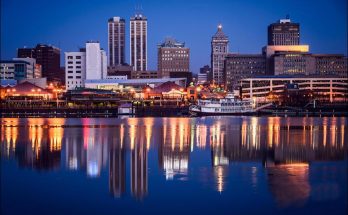
PEORIA (608 alt., 112,936 pop.), named for an Indian tribe, is the seat of Peoria County and Illinois’ second largest city. The Peoria Metropolitan Statistical Area had a population of 369,161 in 2005. Slightly north and west of the center of the State, the city lies on three levels along the northwest bank of the Illinois River, where it widens into a broad basin known as Lake Peoria. The river has been a notable factor in both the early settlement and the present industrial prominence of Peoria.

On the river’s narrow alluvial plain are many of Peoria’s major industrial plants, grouped there partly because of their early dependence on water power, but largely to make use of cheap water transportation. A river and rail terminal maintained by the city serves as a ligature between its 14 railroads and the barge lines that connect upstream with Chicago, by way of the Sanitary and Ship Canal, and downstream with the Gulf of Mexico, along the Mississippi.

Paralleling the band of industrial establishments in the lowlands is a second bench, higher and wider, anciently the river’s bed. On it lie the business district and an extensive residential section. This level runs back from one to two miles to the Bluffs, the earliest bank of the river. From the Bluffs residential Peoria commands a view of the clustered business district, the serrated line of mills and factories along the curving river, and, far beyond the industrial suburbs, the checkered farm fields. Grand View Drive and the Galena Road, both branching from the end of Adams Street at the entrance to Grand View Park, offer fine views of the region.

From neighboring fields and from countless more throughout the Corn Belt, Peoria’s four distilleries draw a considerable portion of the corn crop. With five rectifying plants, the distilleries produce a greater volume of spirituous liquors than any other city in the United States, and together yield $50,000,000 annually to the Internal Revenue Department. Because of Peoria’s supply of pure water and its nearness to corn and coal, it has been a distilling center since the middle of the nineteenth century.

The first white men to reach this site were Father Marquette and the explorer, Jolliet, who passed through Lake Peoria in the fall of 1673, returning from their exploratory trip down the Mississippi. In his Recite Marquette mentions meeting the Indians “of Peourea,” but this encounter did not occur here. The expedition erected no buildings, but the teachings of Marquette and his promise of the French king’s protection against the Iroquois warriors from the north established mutual friendliness and confidence. But early quarrels among the French, Jesuits on the one side and imperialists on the other, later conflicts between the French and English, and finally the war between the American Colonists and the English, shifted protection of the tribes from group to group until they lost all confidence in the “Great White Father,” whose identity was always changing.

Marquette did not return, but in 1680 Robert Cavelier, Sieur de La Salle, with Henri de Tonti, Père Louis Hennepin, a group of Recollect friars and artisans, about 33 men in all, descended the Illinois River to Lake Peoria. At the outlet of the lake, on the left bank of the river, they erected Fort Crèvecoeur, “the refuge of the broken heart.” Despite romantic legends to the contrary, the fort was probably so named to commemorate the then recent French capture of Fort Crèvecoeur in the Netherlands. Its name, however, foreshadowed its history, for within three months it was plundered and abandoned by its forces during La Salle’s absence.

In 1691 Fort St. Louis, upstream from Peoria on Starved Rock, was abandoned, and the post moved to Lake Peoria, where it was usually referred to as Fort Pimiteoui (Ind., fat lake). On the settlement that grew up about it, Peoria bases its claim to being the oldest city in Illinois against the claim of Cahokia, founded in 1699. Settlement at this spot was not continuous after 1691, but certainly this was the first Illinois settlement on a site that is occupied today.

Center of a large tribe of friendly Indians, and possessing excellent transportation to key French settlements, the trading post thrived, and soon was ranked among the most important in this new country. In 1763 the British wrested control of the area from the French, but the treaty which concluded the French and Indian War exerted little influence here. Although the settlement was virtually abandoned during the Revolutionary War, the French returned, took up residence at a new village on the right bank of the river, and continued their trading well into the period of American jurisdiction. Historically unique among Illinois towns, the village at Peoria Lake was visited by two military expeditions during the Revolutionary War. The first, a group of George Rogers Clark’s men, destroyed the Indian village here. In 1781 a company of Spaniards, French, and Indians came up the Illinois river to Peoria Lake, and from here crossed by land to the British post of St. Joseph, in Michigan, which they captured without a battle.

The new village to which the French returned was variously referred to as Au Pé, Le Pé, Opa, and Au Pay, and as early as 1790 there is reference to it as Piorias–the “s” was not pronounced–but it is not known when that name achieved common usage.

During the War of 1812 a military blunder on the part of the American forces resulted in the partial destruction of Au Pé. Alarmed at the depredations of the Indians, Governor Ninian Edwards led troops up from Edwardsville and destroyed the village of Black Partridge, unaware that the chief was rendering assistance in the attempt to recover Americans kidnapped at the Fort Dearborn massacre. Shortly afterward, another part of the same force, under Capt. Thomas Craig of Shawneetown, destroyed a large part of the French village and carried off its inhabitants. Subsequently the friendliness-or at least the neutrality–of the French was proved, and they were released.

On the site of Au Pé late in 1813 the Americans erected Fort Clark, and about it grew up the nucleus of modern Peoria, although the name of Fort Clark clung to it for more than 10 years. In 1819 the first American civilians arrived, a party of seven, forerunners of the swarm of land-seekers soon to follow. The river that had borne French traders and their cargoes for more than a century now helped bring in the tide of “movers,” of New England farmers eager for cheap rich land, and the smattering of professional men who followed the first contingent of ground-breakers.

In 1825 Peoria County was created, and the community of Fort Clark, with the French-Indian name of Peoria officially restored, was designated county seat. Although Putnam County was laid out at the same time, comprising almost all of Illinois north of Peoria, no governmental machinery was set up for that county and business was transacted at Peoria. From here, for a period of six years, jurisdiction was exercised over one-fourth of Illinois, including the stripling village of Chicago.

Largely because of the broad river at its door, Peoria had almost a decade’s lead in appreciable settlement over other large cities in North Central Illinois, antedating Galesburg and Bloomington. When the first steamboat came up the Illinois about 1828, it found a sizeable cluster of cabins at the lake. In 1835, when Peoria was incorporated as a town, it had a population of more than 500. A decade later it had grown to 2,000, and by 1845 had adopted a city charter.

In 1854 the bustling young village was the scene of a highly important event in the career of Lincoln. On October 16, after Stephen Douglas had spoken all afternoon, Lincoln rose and requested that the crowd return after supper to hear his rebuttal. That evening he addressed to them a longer version of a speech he had given 12 days earlier at Springfield. Concerning the speech, Albert Beveridge says, in his Abraham Lincoln, “Thus did Lincoln, for the first time in his life, publicly and in forthright words denounce slavery, and assert that it was incompatible with American institutions.” The speech was not one of the series known as the Lincoln-Douglas Debates, which it antedated by four years.

Pork packing was one of the earliest industries; beef packing came later, and both are still carried on. In the 1840′s began the first stirrings of the intense industrialization that quadrupled the population between 1850 and 1870. Early entering the profitable industry of farm implement manufacture, Peoria was making plows, threshing machines, and fanning mills by 1844. By 1860 the city had seven distilleries, with a capital investment of $700,000. At first highly competitive, the distilleries became part of the Cattle Feeders’ and Distillers’ Trust–the “Whiskey Trust”–organized by Joseph Greenhut of Peoria in the 1880′s. Small distilleries were closed, and the trade was concentrated at 12 large plants, 6 of which were in Peoria. So effective was this combine that between 1870 and 1890 the number of distilleries in Illinois declined from 45 to 7, while the average output rose in value from $175,300 to $7,448,000 annually. The organization continued in existence until the early 1900′s, when the wave of “trust-busting” effected its dissolution.

Nauvoo, Illinois

nauvoo.jpg

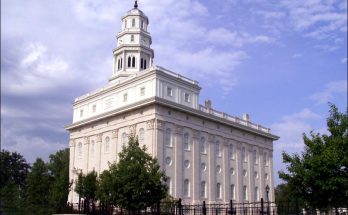
NAUVOO (620 alt., 966 pop.), the city built up by Joseph Smith, stands on a promontory around which the Mississippi River flows, some fifty miles north of Quincy, Illinois. Here, when Chicago was a stripling village of less than 5,000, stood the largest city in Illinois, the headquarters for the newly established Church of Jesus Christ of Latter-day Saints, popularly known as the Mormons.

In no sense of the word is Nauvoo a ghost town, but the bones of a greater past show starkly, here and there, in the living town of today. Scattered throughout are empty foundation pits, with elms and maples leaning over, and here and there the shell of a house, its windows boarded and its collapsed roof spilling a great crest of trumpet flowers. Occupying two levels, which residents call the Hill and the Flat, the town sprawls loosely over an area capable of housing a community twenty times its size. Extending almost to the back doors of its business establishments are vineyards and garden plots, as though a dam that once had barred country fields from the town had fissured and let the fields come seeping in.

The Flat graphically presents the fact that Nauvoo occupies the framework of a larger and older community. The checkerboard streets laid out by the Mormons are still discernible, although many of them are now delineated only by the fences of bordering farms. A scant two score of houses remain in what was once the most populous section of the city. Main Street and Parley Street have but few buildings facing them, although the former was the business street of old Nauvoo, and the latter, according to a visitor in the 1840′s, was lined solidly with houses for more than a mile back from the river.

The living city, which centers around the crest of the hill, is a quiet, stable little community almost wholly dependent upon agricul

ture and horticulture. A recently established aeronautical school strikes an anachronistic note; there are two Roman Catholic boarding schools, a cheese factory, and a winery, but most of Nauvoo’s citizens look to the soil for their livelihood. Grape culture, instituted by the French communists who occupied Nauvoo after the expulsion of the Mormons, remains the most important source of income. Many thousands of gallons of wine and grape juice are pressed annually; the remainder of the crop is shipped out. Most of this leaves by truck or ferry.

When the Mormons, harried out of Missouri by an irate citizenry, came to this place in the spring of 1839, there was nothing here but half a dozen buildings in what pretentiously called itself the town of Commerce. “The place,” wrote Joseph Smith, “was literally a wilderness . . . but believing that it might become a healthy place by the blessing of Heaven to the Saints, and no more eligible place presenting itself, I considered it wisdom to make an attempt to build up a city.” Shortly he renamed the town Nauvoo, to which many writers and others have properly added the phrase–”the beautiful.”

Smith had founded his church nine years before, at Fayette, New York, shortly after he had published the Book of Mormon, which he offered as an addendum to the Bible. The book, he claimed, was a divinely inspired translation of a set of gold plates that he had dug up, under the guidance of an angel, on a hill near Palmyra, New York.

By shrewdly bargaining their political support, the Saints obtained a highly favorable charter for Nauvoo from the legislature. Nauvoo was made virtually an autonomous state, empowered to pass any laws not in direct conflict with the State or Federal constitutions, and to maintain its own militia and city court.

While bricklayers and carpenters were fashioning a city out of the

wilderness, Smith dispatched missionaries to the Fast and to Europe. In England they began publishing the Millenial Star, still in existence, and distributed thousands of copies of the Book of Mormon. Hundreds of immigrants began pouring into the new Zion, and by the fall of 1842 the new Mormon paper, Times and Seasons, estimated that Nauvoo contained “between 7,000 and 8,000 houses, with a population Of 14,000 or 15,000.” In 1841 the Saints began work on a great temple and a hotel, the Nauvoo House, as dictated in a revelation to Smith. At its peak, in 1845, the city had more than 20,000 inhabitants.

As the city spread over the promontory, opposition began to rumble among the Gentiles, as the non-Mormons were called. The Saints usually voted as a bloc and their neighbors feared political domination. Opposition grew when John C. Bennett, an opportunistic politician who had lobbied for the city charter, broke with the Saints and published in 1842 a lurid booklet, History of the Saints; or an Exposé of Joe Smith and Mormonism, which made the first detailed charges of polygamy against the Mormons.

Polygamy was never openly practiced at Nauvoo; not until 1852, in Utah, did Brigham Young announce the “plural wives” revelation, which he claimed Smith had received at Nauvoo on July 12, 1843. The Reorganized Church has consistently denied the authenticity of this revelation, but it is incontrovertible that rumors of polygamy at Nauvoo were rife in this region long before Smith’s death.

The Prophet reached the height of his career in 1844, when, following unsuccessful attempts to secure reparation from Missouri for the confiscation of Mormon property, he announced himself as a candidate for the presidency of the United States. Some historians have questioned the seriousness of his intentions, although hundreds of the most eloquent church leaders were sent out to preach their religion and to electioneer for him.

Then suddenly occurred a schism that rocked the church. William and Wilson Law, Dr. R. D. Foster, Sylvester Emmons, and a few of their friends unexpectedly broke with the church, and on June 7, 1844, published the first and only issue of the Expositor. “We are aware,” ran the preamble, “that we are hazarding every earthly blessing, particularly property, and probably life itself, in striking this blow at tyranny and oppression.” They attacked polygamy and the political aspirations of Smith, and called for repeal of the powerful city charter.

The city marshal, on Smith’s order, immediately destroyed the press, pied the type, and burned the remaining copies of the Expositor. The Laws fled to Carthage and procured a warrant for the arrest of Smith and other Mormon leaders. The Prophet and his brother surrendered themselves and were jailed. Mobs began to form, wild rumors circulated among both Gentiles and Mormons, and Governor Ford hurried to Carthage to quiet the unrest.

On June 27, while Ford was at Nauvoo assuring the uneasy Saints that Smith would receive justice, a mob stormed the jail at Carthage and murdered the Prophet and his brother Hyrum, the Patriarch.

The Mormon leaders preaching and campaigning in the East hurriedly returned to Nauvoo, and Brigham Young soon took command. But opposition to the Saints abated only temporarily. In January 1845, the Nauvoo charter was repealed, and armed clashes continued throughout the summer. Then, on September 24, Young announced that “as soon as grass grows,” the Saints would leave Illinois and migrate to a distant place.

Nauvoo was transformed into a gigantic wagon shop, and the town echoed continually with the sound of hammer and saw. Property was disposed of at a fraction of its value; horses and oxen were at a premium. In February, 1846, Brigham Young led the first body of Saints across the Mississippi, and by spring the number of emigrants averaged one thousand a week. But rumors persisted that many of the Saints were planning to remain, and an armed force of Gentiles attacked the town. For several days there was open warfare, which ceased only when the remaining Mormons agreed to leave immediately. “The ferry boats were crowded,” wrote an eye-witness, “and the river bank was lined with anxious fugitives, sadly awaiting their turn to pass over and take up their solitary march to the wilderness.” Out of this epic march came the settlement of Utah and the final achievement of peace and prosperity by the Saints.

Nauvoo was left deserted. Weeds took root in the streets, and rats scurried fearlessly through the open doors of Saints’ houses. The Temple, which had been almost completed, stood mute and staring above the abandoned city. Late in 1848 it was fired by an incendiary, and only the walls were left standing.

Then, in 1849, a small band of French communists, the Icarians, came to Nauvoo from Texas, where they had made a brief and unsuccessful attempt to found a colony. At their head was Etienne Cabet, prominent French jurist, author of Voyage to Icaria, and True Christianity, in which he had advocated a communistic society based on the moral teachings of Christ.

The Icarians soon set up a community governed by a president, elected annually, and by a cabinet of directors for each division of activity. The workshops and labor gangs were supervised by foremen elected monthly by the workers. Possession of money was restricted to the director of finance; shoes and clothing were supplied from the common fund. Icarian children, who entered the colony’s school at the age of seven, were permitted to visit their parents on Sundays only, and were trained to manage the dormitories where they lived.

Fascinated by the ruins of the Temple, Cabet decided to reconstruct it. After a considerable sum of money had been spent, a terrific storm struck Nauvoo, and seeming to single out the Temple, felled the walls with a roar that was heard miles away.

Already saddled with considerable debt, the Icarians began to grumble against Cabet. Shirking became contagious, production slackened, and individualism crept into the colony. “The beast began to show itself,” wrote Emile Vallet. “Having been raised under the influence of individualism, we could not be expected to fulfill the requirements of such a mode of life.” In winter the coal that was to be equally divided among all was carried away by a few as soon as it arrived; a greedy few at the table would consume the butter intended for all.

Steadily Cabet lost his followers’ esteem, and in 1856 he was defeated for the presidency. When he organized a strike, the majority locked the dining hall door, and finally, realizing that the breach could not be healed, Cabet and his followers withdrew to St. Louis. There, unattended and brooding over the failure of his plans, the Utopian died. The majority group sold their property and joined forces with a branch colony established in 1853 at Corning, Iowa. This group, faring somewhat better, held together for about twenty years.

Thus ended the unconventional days of Nauvoo. Gradual resettlement, much of it by Germans, began in the late fifties and sixties, but not in sufficient numbers to occupy the community left by the Mormons. Most of the frame buildings fell into ruin and were torn down, and by degrees Nauvoo scaled itself down to its present size. The façade of the Temple, somber and ruined on the crest of the Hill, was at last condemned and torn down. The limestone blocks went into the construction of many a house and commercial building, thus diffusing throughout the city the Temple that Joseph Smith had planned as the spiritual center and material glory of Nauvoo.

Joliet, Illinois

joliet.jpg

JOLIET (607 alt., 145,800 pop.), the seat of Will County, lies 35 miles southwest of Chicago, on the Des Plaines River and the Illinois and Michigan Canal, a part of the Great Lakes to Gulf Waterway. Here the outer belt freight lines shunt much of the through freight around Chicago. Concerned with its freight handling and possessed of early transportation advantages, Joliet has developed as a selfdependent unit; here one senses little or no dependence upon the metropolis looming a scant hour’s drive to the northeast. Joliet reveals its economic independence from almost every approach, in railway yards, warehouses, shipping platforms, quarries, factory stacks, and mountains of coal.

This is the Joliet of which Sandburg wrote, years ago:

On the one hand the steel works
On the other hand the penitentiary.
Santa Fe trains and Alton trains
Between smokestacks on the west
And gray walls on the east . . .

But this is not all of Joliet; the man-of-the-street scarcely gives a thought to the penitentiary, so little does it intrude upon the life of the’ town. Across the north side of town stretches the Joliet park system, which, although planned too late to include areas in the city proper, is one of the finest among the small cities of the State. If the average resident were asked what is the most outstanding thing about his town, he would probably say the high school band, followed by the park system, and mention the penitentiary as an afterthought.

The first settler here was Charles Reed, who came in 1831. The following year he, along with numerous settlers in the vicinity, fled the region when the Black Hawk War broke out, but before the war was over they returned, and by 1834 a town was laid out and the first public sale of lots was held. By some unexplained quirk, the town was known as Juliet for years, and a nearby village romantically took the name of Romeo. When Will County was laid out in 1836, the designated county seat was referred to under the name of Shakespeare’s heroine, and a year later it was incorporated with that name.

For ten years the fortunes of Joliet rose and fell as work went forward or languished on the canal. The first boat arrived here April 11, 1848, and was met by the entire population, with bands, booming cannon, and much oratory. With its new transportation means, Joliet entered into its first industrial era, based on the large-scale shipping of local limestone. In the fifties and sixties Joliet shipped blocks as far as New York, and its quarries provided the Middle West with material for such public structures as the Rock Island Arsenal, the Indiana penitentiary, and the State House and Lincoln monument at Springfield.

The first railroad, the Rock Island, came here in 1852, followed by five other lines. Although the railroad was eventually to cause the decline of the canal it brought, in the seventies, the new industry of steel manufacture, which was further attracted by the soft coal in the vicinity. The earliest mill manufactured spikes, track bolts, and other railroad items. Bessemer plants, rail and rod mills, blast furnaces followed, and then plants that made galvanized wire, barbed wire, nails, and other products for the growing agricultural west.

In 1894 Joliet pioneered notably in the elimination of grade cross

ings, seeking to require the railroads to elevate their tracks in the major portion of the city. In and out of courts the battle was fought, with the lines objecting strenuously to the ordinance that had been passed. Finally, in 1904, a compromise plan was effected, and within the next decade the work was completed. The program, which eliminated a score of dangerous crossings and consolidated all passenger service in one station, brought numerous queries from other cities that were spurred to emulate the plan.

The rise of the Chicago area as a steel-producing center wooed away from Joliet some of the mills engaged in heavier manufacture. But the lighter processing mills remain, surrounded by a plexus of plants that manufacture power corn shellers, soap, jewelry, packaging machines, flyspray, ink, sulphuric acid, steel washers, and shoes with which horses all over the world are shod. The outer belt railroad is still Will County’s largest employer, but the glinting waterway, which Sandburg saw as “stripes of silver or copper or gold” still moves its freight through town, its quaint donkeys long discarded for power-boats as efficient as the factories they slip past.