Kentucky

What the Middle West is, Ohio, Indiana, Ohio River, Kentucky

Ohio River

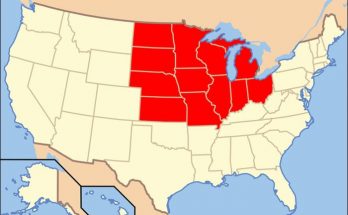
Nobody knows quite what the Middle West is, for the geographers, the sociologists and the political economists have never agreed upon a satisfactory definition of it. It is an amorphous region, a slab of eight or nine states deposited in the center of America, surrounded by areas of more decided and homogeneous character–the melancholy South, the vivid expanse of the West, the mellowed East. Hardly anybody wants to be a Midwesterner, for the area does not possess the allure of the West, nor the fragrant nostalgia of the plantations. Within its nebulous frontiers there are shades of every social flavor, from the feudal pride of the southern states to the backwoods temperament of the territories that lie along the fortyninth parallel.

The accepted southern border of the Middle West is the Ohio River, which runs placidly through beautiful wooded hills to join the Mississippi at Cairo. Across the river is Kentucky, which is very conscious of its southern connotations (whisky, colonels, gallantry, blue grass and fine horses, Confederate memories and strong convictions); but on both sides of the stream there are river towns of unmistakable Middle Western atmosphere. There may be racial segregation in Hawesville, Kentucky, for example, while across the Ohio in Indiana the Negro is theoretically emancipated; but the people of Hawesville speak with the rasping and angular speech of the Middle West, not the lilt of the South, and they probably have fewer affinities with their fastidious capital, Frankfort, than with the metallic drive of Indianapolis (where an official pamphlet says of the ugliest of all war memorials that it is “universally admitted to be the grandest achievement of Architectural and Sculptural Art in the World”). These places, standing like bastions along the river, are frontier towns, marking the boundary where one philosophy of life gives way to another; and the most important of them, the splendid old river port of Louisville, was my own southern gateway into the Middle West.

Far in the north near the Canadian border, surrounded by forestlands and lonely lakes, lie the iron mines of the Mesabi range, in Minnesota. For decades these were the ultimate source of American strength; because of the presence of these mines, America was able to feed her greedy steel mills, laying the foundations of her power and influence, winning her wars, enriching her magnates. The chief city of the iron country is Duluth on the shores of Lake Superior, a place as far in spirit from the Kentucky Derby or the civilization of the mint julep as Leeds is from Darjeeling (though the name is aristocratic, for the city was called after Daniel de Greysolon Sieur de Lhut). This is a hard northern country, healthy but unenticing of climate; not so moist or endearing as the Pacific Northwest, but similarly Scandinavian in some of its aspects.

Illinois History 19th Century 1818-1848

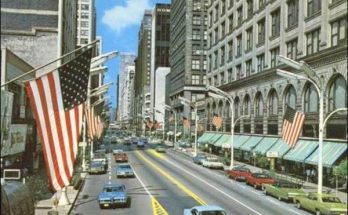
Michigan Avenue, Chicago, Illinois

Michigan Avenue, Chicago, Illinois Masterprint
18 in. x 12 in.
Buy at AllPosters.com
Framed   Mounted

Through the gateway at Shawneetown, down the main highway of the Ohio River, settlers converged upon the young State from many directions–from North Carolina, Tennessee, Virginia, Kentucky, Maryland, Pennsylvania, New York, and the New England States. In flatboats and keelboats loaded with horses, cattle, and furniture, they came. Some, too poor to pay for this kind of transportation, struck out across country and braved the wilderness.

“The eye sometimes surveys the green prairie without discovering on the illimitable plain a tree or bush, or any other object, save the wilderness of flowers and grass,” wrote an English traveler who crossed the State in the twenties. “On other occasions the view is enlivened by groves dispersed like islands on the plain, or by a solitary tree rising above the wilderness.”

Because of a widespread belief in the superior fertility of woodland, because of the toughness of the prairie sod and the pioneer’s constant need for timber, the first settlers built their cabins along the river bottoms and in the groves. But as population increased and desirable sites became scarce, hardy adventurers pushed out into the prairies, and thus discovered the almost limitless richness of the great treeless regions.

Despite hardships, they kept coming, first the advance guard of lone-wolf trappers and hunters, then the poor squatters, followed by farmers with stock and capital, and finally young men of education seeking their fortunes in land and trade. Socialistic and religious colonies organized elsewhere and migrated here: Birkbeck’s English colony at Albion ( 1818), the Quakers on the Fox River ( 1835), Swiss wine-grape growers along the Ohio, Bishop Chase and his jubilee College at Robin’s Nest ( 1839), later the Swedish Janssonists at Bishop Hill ( 1846), and the Mormons ( 1839) and Icarians ( 1850) at Nauvoo.

In Illinois As It Is, Fred Gerhard wrote in a chapter entitled “Hints To Immigrants”: “A pair of good horses, a wagon, a cow, a couple of pigs, several domestic fowl, two ploughs (one for breaking the prairie, and the other for tillage), together with a few other tools and implements, are all that is necessary for a beginning. A log house can soon be erected.”

The frontier towns were busy centers of trade; the produce of the land and the forest–furs, skins, honey, corn, whiskey, venison, beef, pork–could be bartered for goods and shipped down to New Orleans in flatboats. In these towns all elements rubbed elbows, “the young college graduate and the lone-wolf trapper, the fine lady and the squatter’s wife.”

But the great curse of the expanding frontier fell on these towns and farms: they lacked capital. The produce of the West poured down the Mississippi–only to accumulate on the wharves at New Orleans. The small sums of money that dribbled through to the West went directly back East to pay debts. The Federal banking system, inadequate in its credit mechanisms, and the State banks, unstable and uncontrolled, made merchants and farmers distrustful of all banking systems. The State banks at Edwardsville and Shawneetown failed in the early twenties, but in the late thirties a much more serious confusion occurred, in both Federal and State banking systems. Soon all bank notes were so suspect that barter of tangibles was quite commonly preferred to any kind of paper money. But there was only a small market for produce, and debt-ridden farmers, unable to dispose of their goods and too numerous to be dispossessed, filled the State.

Not far behind the first settlers came the frontier church. A Methodist circuit-rider, the Reverend Joseph Lillard, stopped at New Design in 1793. The first Baptist church was founded there three years later; the denomination was strengthened by the coming of John Mason Peck and his establishment, the Rock Spring Seminary, in 1827. The Methodists, with their circuit-riding preachers, began to arrive in 1801; they taught simplicity in dress and living, and sowed the beginnings of the anti-slavery movement in the State. In 1796 came the Presbyterians with the Reverend John Evans at their head; insisting on a learned clergy, they quickly established their denominational colleges. Despite its early missionary work and the adherence of the French settlers, the Catholic church grew more slowly; not until 1844 was the separate diocese of Chicago established.

The question of public education was debated bitterly. The largest part of the population had been drawn from the South, which had developed no public school systems. Those from the North thought that education was a function of the church. Finally, in 1825, a law allowing localities to levy school taxes was passed, only to be repealed soon afterwards; it was not until 1845, as the result of a campaign waged by the workers and farmers of the State, that a free education law was again passed, and even then years elapsed before many communities took advantage of it.

The population of the State grew from 55,211 in 1820 to 157,445 in 1830. With this growth came a tremendous shift in the distribution of population. Opened in 1825, the Erie Canal brought swarms of immigrants by way of the Great Lakes, repeating the process of settlement that had been occurring through the Ohio River Valley for half a century. Fort Dearborn, rebuilt in 1816, was the nucleus of a settlement incorporated as the town of Chicago in 1833, and as a city in 1837.

A feverish campaign for internal improvements spread in the thirties; by the end of the decade the movement had brought the State to the verge of bankruptcy under a staggering debt of $14,000,000. In 1837 a flood of measures had been passed by the legislature, providing for the building of railroads, canals, and turnpikes, and the improvement of rivers and harbors. A canal charter had been granted in 1825; in 1827 Congress had given 224,322 acres to the State. The Illinois and Michigan Canal was begun in 1836. The Wabash, Illinois, Kaskaskia and Rock Rivers were to be deepened and improved. A great Illinois Central Railroad from the western terminus of the canal at La Salle to the mouth of the Ohio River at Cairo was proposed, with two east-west lines, “the Southern Cross” from Alton to Mount Carmel, and “the Northern Cross” through Springfield and Quincy.

At the same time the question of removing the State capital from Vandalia arose; Alton, Jacksonville, Peoria, Springfield, and others, wished to succeed it. They also wanted the benefits of the internal improvements. Consequently, in the session of 1837, the Sangamon County delegates, called the “Long Nine,” because all its members-including Abraham Lincoln–were exceptionally tall men, arranged a trade. They voted internal improvements for these towns in return for votes for Springfield as the capital.

The hysteria of the internal improvement scheme was broken by the panic of 1837. For the enormous debt with which the State was burdened, it was able to show only one short railroad line, the Northern Cross from Springfield to Meredosia; built at a cost of $1,850,000, the road was sold at auction some years later for $21,000. The Illinois and Michigan Canal, begun in 1836, was not completed until 1848.

A tragic episode in the history of the State, the Black Hawk War of 1832, saw the passing of the Indian from Illinois forever. The Sauk and Fox once claimed all the land west of the Fox and the Illinois, and east of the Mississippi Rivers. In 1804, while five of their chiefs were in St. Louis arranging for the release of one of their tribesmen charged with murder, they were plied with drink. In return for an annuity of a thousand dollars a year, and the right to live and hunt in the area so long as it belonged to the Federal government, they deeded the land away.

In 1816, 1822, and 1825, the agreement was renewed, although how well the Indian chiefs understood the terms of these treaties will always remain a mystery. The tribes continued to live at their great villages, the Sauk on the north side of Rock River near the present city of Rock Island, and the Fox three miles away on the Mississippi. Miners heading for the newly discovered lead mines at Galena saw their fertile lands, and by 1825 white settlers began to move in upon them. Realizing the inevitability of a conflict, Keokuk, the peace-time chief of the tribes, decided to move Pcross the Mississippi into what is now Iowa.

But Black Hawk, a war chief less friendly to the settlers, persuaded by British and Indian friends that one thousand dollars a year was manifestly inadequate payment for this vast region, decided to remain on the land. The majority of the tribe left for Iowa, but friction soon developed between those who remained and the settlers; Black Hawk ordered the whites to stop plowing up the burial grounds of his ancestors and planting in the cornfields of the tribes. Governor Reynolds proclaimed Illinois in a “state of actual invasion” by the Indians and called for volunteers. When the volunteer army approached the Indian village on June 25, 1831, Black Hawk ordered the village abandoned, and under cover of night the Indians moved across the Mississippi into Iowa without a struggle.

In the spring of 1832, Black Hawk and four hundred braves, together with their women and children, crossed the Mississippi, apparently intending to go to the Winnebago in Wisconsin, and raise a corn crop with them. Their mission was misunderstood, and troops again took the field. Under Major Isaiah Stillman, they came upon the Indians encamped. Black Hawk sent three braves with white flags to explain that no hostilities were intended. In the excitement accompanying the negotiations, shooting began; three Indian tribesmen, including one of the truce-bearers, were killed. In the ensuing Battle of Stillman’s Run, the white men were ingloriously routed.

Guerrilla warfare began, with the Indians proving elusive in the forests. In July, his forces weakened by hunger, Black Hawk decided to surrender. He wanted to return his people to Iowa, but again his offer of truce went unheeded. Most of the warriors were killed at the Battle of Bad Axe, August 2, 1832, where the white men turned savage and committed indescribable acts of cruelty, even scalping the Indians. As women and children of the tribes tried to cross the Mississippi on rafts, a gunboat opened fire, killing or drowning most of them. Those who escaped the Battle of Bad Axe and managed to cross to the west side of the river were set upon by the Sioux, the traditional enemies of the Sauk and Fox. These events, together with the great peace pow-wow held in Chicago in 1833, in which the Potawatomi and their allies ceded all their land in Illinois and moved west of the Mississippi, removed the last of the Indians from the State.

A decade later came the Mormon wars. Driven from Missouri, the Mormons moved across the Mississippi to the town of Nauvoo in 1839. They received many concessions from the State legislature, and built a community that exceeded Chicago and Galena in population and industry. Then dissension developed; men who were excommunicated, turned on the colony with exposés, charging that the interests in the community of Joseph Smith, the leader, were financial and political rather than spiritual. Trouble with neighbors grew. In 1844 warrants were issued against Joseph Smith and his brother Hyrum for rioting and treason. They were arrested and incarcerated in the jail at Carthage. While the prisoners were awaiting trial, the jail was broken into by a mob on June 27, and the Smith brothers were murdered. Then began the acts of violence which, for two years, amounted almost to civil war, with Governor Ford marching and countermarching the militia across the State in an effort to preserve peace. The problem was finally solved after it had flared into open battle; the Mormons, yielding to superior force, left the State and migrated to Utah.

A new constitution was adopted in 1848. The population of the State increased from 157,445 in 1830 to 851,470 in 1850. The constitution of 1818 was obviously inadequate, and many reforms were needed. The new constitution provided for popular election of all State officials and popular referendum on questions of policy. As a compromise between the township system brought from the North, and that of counties from the South, the new constitution provided for both forms of local organization.

Chicago’s History 1800s

chicago-1930s.jpg

Times were indeed lush at the tip of the lake. Typical of the almost Hollywoodian order of things in that period was the case of the bankrupt backwoods tailor who came to Chicago, sold trousers for a few years, and built one of the largest and most celebrated hostelries of its day. Race tracks, gambling saloons, and bawdy houses multiplied. Lavish “marble” mansions went up along Michigan Avenue to 12th Street. Theaters, hotels, shops, and business buildings crowded into what is now the Loop. Coal yards, warehouses, flour mills, factories, foundries, and distilleries lined the river banks and the lake front. Scattered through the city were 170 churches–25 Catholic, 21 Methodist, 19 Presbyterian, and 5 Jewish, a partial reflection of the fact that half the Chicagoans of that day were foreign-born.

In 1867, after years of violent protest that the entire community was being poisoned by “filthy slush, miscalled water . . . a nauseous chowder” of fish and filth, which was taken from the lake into which the city poured its sewage, a sanitary water system was installed and immediately reduced the appallingly high death rate. The flow of “Garlic Creek” was reversed in 1871, and some of its foul waters were carried down the Illinois into the Mississippi, but not in sufficient quantity, so that sewage continued to pour into the river and the lake, to be thrown back at Chicago by the winds and waves.

Public high schools and evening schools, industrial and professional schools, including one of the first art schools in the country, two colleges, three theological seminaries, the Chicago Historical Society, and the Academy of Sciences were established in this period. In 1869 a ring of unimproved parks with boulevard connections surrounded the “Garden City.” Beyond, in suburban subdivisions, carpenters were hammering out miles of houses that were to be swallowed in the city’s growth within two decades. “More astonishing than the wildest vision of the most vagrant imagination!” visitors exclaimed, and Chicagoans agreed, although they felt that a more accurate index of the city’s superiority over all others was provided when the White Stockings, its professional baseball team, defeated the Memphis nine, 157 to 1.

But, born in the haste to put wall and roof around home and business as quickly and cheaply as possible, a large part of the city’s construction ran to “shams and shingles.” Of the estimated 40,000 Chicago buildings in 1868, more than seven-eights were wooden. In 1871 the total increased 50 per cent, and while the 40 new stone buildings on State Street and many brick and iron-front structures elsewhere were promising improvements, solid blocks knew nothing but flimsy pine.

After months of severe drought a fire of unknown origin started in such a block, in a cow barn behind the cottage of Patrick O’Leary on DeKoven Street, Sunday night, October 8th, 1871. It soon spread beyond the control of the firemen, who were wearied by fighting and celebrating the defeat of a blaze that burned four blocks the previous day. A powerful wind swept flames to the north and northeast and hurled brands in advance of the roaring columns of fire, which destroyed the notorious “Conley’s Patch” and practically everything north of Van Buren Street in the areas now designated as the Downtown District and the Near North Side. So intense were the flames that hot blasts were felt in Holland, Michigan, 100 miles across the lake. Tapering to a point near the lake at Fullerton Avenue, the boundary with the then suburban Lake View, the fire stopped after consuming 17,450 buildings in 27 hours. At least 250 persons perished. Homes of one-third the population, about 1,600 stores, 60 manufacturing establishments and 28 hotels, railroad structures, government and other public buildings, and bridges became three and one-third square miles of ashes and debris. Thousands were penniless, stripped of their last possession.

The embers were scarcely cool before rebuilding began. Generous contributions of money and supplies came from the entire country and from Europe. Thousands of temporary structures provided for immediate needs while more than 100,000 artisans were reconstructing the city under stricter construction codes, although the latter were frequently violated. Extensions of credit and payment of about half of the $88,634,022 insurance on the $192,000,000 loss helped rebuild the business district within a year. In another two, scarcely a scar of the fire remained anywhere. Many buildings, particularly hotels and depots, were replaced by far costlier structures. Fashion took over Michigan Avenue south of 12th Street, and Prairie Avenue, and brought in granite and brownstone. Chicago dumped its debris within the lake breakwater, forming subsoil for a future park, and went about its increasing business. Local manufactures doubled between 1870 and 1873; Chicago banks, alone of those in the larger cities, continued steadily to pay out current funds during the acute financial panic of 1873.

The germ of American industrialism found the Chicago of the middle seventies an ideal medium. A circle of 500 miles contained the principal ingredients. Around western Lake Superior lay one-fifth of the world’s richest iron-ore reserve, yielding at the slightest scratch, easily loaded on lake freighters after a short land haul, and carried away by the most economical form of transportation on the continent. In Illinois, Indiana, Kentucky, West Virginia, and Pennsylvania, Chicago’s railroads clutched at a trillion tons of coal. Blast furnaces and large factories forged tremendous wealth that filled Prairie Avenue and spread into Lake Shore Drive.

Nationwide labor unrest, following the wave of western settlement that had “broken against the and plains” became particularly acute here. The line between wealth and poverty, cutting sharply into a single generation of workmen with rapidity unequalled elsewhere, drew Chicago into the forefront of “radical” cities. In 1877, led by Albert R. Parsons, workers in the factories and on the railroads struck for increased wages and the 8-hour day. Federal troops broke the strike, but without removing the causes of discontent. Industrial warfare over wages and hours grew increasingly bitter and culminated in the Haymarket bombing of 1886. Although no adequate evidence was produced that they had thrown the bomb, Parsons and three other labor leaders were hanged for the crime. Two others escaped death by having their sentences commuted to life imprisonment, and a third received a sentence of 15 years in prison. These three were pardoned seven years later by Governor John P. Altgeld, “. . . eagle forgotten” in Vachel Lindsay’s phrase, who denounced the trials as unfair and illegal and was himself denounced as little better than a criminal for daring to doubt highly questionable evidence. Again large strikes broke out in the depression years that followed 1893, notably that which began in the local Pullman shops and spread to the railroads; once more Federal troops broke the strike.

Meantime, as one result of the Haymarket tragedy, the Civic Federation was founded by Lyman C. Gage, a banker, to provide free and open discussion of controversial questions. In 1889 Jane Addams opened Hull House in the worst slum district on the West Side. By 1890 Chicago had more than 1,000,000 people, having added 200,000 the previous year by the annexation of several surrounding municipalities. The Newberry Library, and The Public Library, had been founded, and in 1892 the University of Chicago began with the most auspicious program in university history. Theodore Thomas had organized the Chicago Orchestral Association and had long been presenting the popular concert series that brought the city renown as a musical center. W. L. B. Jenny, Daniel H. Burnham, John W. Root, William Holabird, and other architects were constructing huge new buildings on steel frames and evolving a new architectural form. In Maitland Dictionary of American Slang, published in 1891, the new term “skyscraper” was defined as “a very tall building such as are now being built in Chicago.”

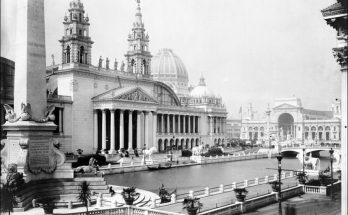
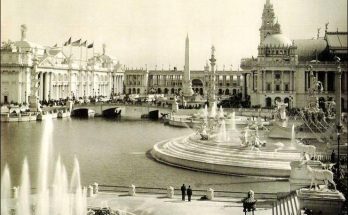
Commerce, manufacture, labor, and these new cultural developments united to bring the city one of its great triumphs, the World’s Columbian Exposition of 1893, in celebration of the 400th anniversary of the discovery of America. Jackson Park was developed out of swamp land on the South Side and here were built the great white buildings of the Fair in accordance with a master plan drawn by Daniel H. Burnham. The “White City,” as it was soon known on five continents, was hailed as the miracle of the day, the “miniature of an ideal city . . . built as a unit on a single architectural plan . . . a symbol of regeneration.” Millions crowded into the Fair to stare at and be equally impressed with “the most beautiful building since the Parthenon,” a knight on horseback made of California prunes, cannons by Krupp, the Tower of Light, and the Parliament of Religions–the whole providing “matter of study to fill 100 years.”