Michigan

First existing records of white men in Illinois

The first existing records of white men in Illinois were made by Father Jacques Marquette. On May 17, 1673, he and Louis Jolliet, with five voyageurs, left Mackinac, paddled over parts of Lakes Huron and Michigan into Green Bay, thence up the Fox River, crossed at the portage, and went down the Wisconsin.

On June 17 they entered the Mississippi. On the west side of the river, in what is now Iowa, they encountered and exchanged friendly greetings with the Kaskaskia tribe of Illinois Indians. The adventurers passed the mouth of the Missouri, saw the famous Piasa or Thunder Bird painted on the cliffs near the present city of Alton, and reached the mouths of the Ohio and Arkansas Rivers. There, having determined that the Mississippi flowed not into some western ocean, but into the Gulf of Mexico, and fearing Spaniards and hostile Indians, the Marquette party turned back late in July 1673.

sitting bison postage p172765131837122723anr9r 500 First existing records of white men in Illinois
Sitting Bison by made_in_atlantis
Make custom postage with Zazzle.com

They returned by way of the Illinois River, which Marquette described in his Journal: “We have seen nothing like this river for the fertility of the land, its prairies, woods, wild cattle, stag, deer, ducks, parrots, and even beaver.” And Jolliet later reported that the valley was “the most beautiful and most suitable for settlement.”

Near Starved Rock they encountered the same tribe of Kaskaskia, now returned to their ancestral village site (about nine miles below the town of Ottawa), and their friendliness so won Father Marquette that he promised to return and set up a mission among them. From the Desplaines River they took the ancient portage trail to the Chicago River, thence to Lake Michigan, and up to Green Bay. Here Marquette, ill from the hardships of the voyage, was left behind, and Jolliet went on alone to Montreal where, almost in sight of the town, his canoe overturned and his carefully kept Journal was lost. Nevertheless he gave enthusiastic verbal descriptions of the new country, of its fertility, and ease of cultivation; he spoke of its marvelous transportation facilities, and showed how, with a canal built through “but half a league of prairie,” a boat could sail from Lake Erie down the Mississippi to the Gulf of Mexico.

On October 25, 1674, with two voyageurs as companions, Father Marquette set out from Green Bay to keep his promise to the Kaskaskia. The voyage proved a hard one, and not until December 4 did the party reach the mouth of the Chicago River. Because of the severe cold and the recurrence of his old illness, Marquette stopped “two leagues” above the mouth of the river for the winter. With the spring his strength returned, and in Easter week, 1675, he established the first mission in the Illinois country at the Great Village of the Illinois, calling it the Mission of the Immaculate Conception of the Blessed Virgin. But then, weakened again by illness, he decided to return to St. Ignace (Mackinac). He was canoed up the eastern shore of Lake Michigan by his two faithful companions; finally, when he was unable to go farther, they landed near the river named for him in the present State of Michigan. There, on May 18, 1675, he died.

Robert René Cavelier, Sieur de La Salle, the French explorer, came later to the Illinois country. In 1679, after the sinking of his Griffon on Lake Erie, he erected a fort at the mouth of the St. Joseph River, ascended that river, portaged to the Kankakee, and canoed up the Illinois River to Lake Peoria, where he made friends with the Peoria tribe of the Illinois. About two miles below the lake, on the south side of the river, he built Fort Crèvecoeur in January 1680. In his absence the men mutinied and plundered the fort, and raiding Iroquois burned the Peoria village. Upon his return to the Illinois Country in 1682, La Salle, with Tonti, built Fort St. Louis at Starved Rock as a key to the vast empire of forts and commerce he had conceived. But his enemies at court prevailed, and he was soon recalled. Returning to France, he received permission from the king to establish a colony at the mouth of the Mississippi; on March 20, 1687, on a branch of the Trinity River, he was shot from ambush.

Tonti, La Salle’s lieutenant, obtained in 1690 the privileges previously granted La Salle. In 1691-92 he moved Fort St. Louis from Starved Rock to Pimitoui, on Peoria Lake. For ten years he devoted himself to bringing in settlers, missionaries, and trade supplies. When he died in 1704, a chain of forts stretched from Montreal to Mobile. Tonti had at last succeeded where his chief, La Salle, had failed.

The Mission of the Holy Family was established at Cahokia in 1699 by priests of the Seminary of Foreign Missions. In 1703 the Jesuits moved the Mission of the Immaculate Conception to the Indian village of Kaskaskia, sixty miles below Cahokia, a short distance from the mouth of the Kaskaskia River. These two towns on the American Bottom, Cahokia and Kaskaskia, soon became the centers of French life in the Illinois country. In 1720, after the collapse of the Mississippi Bubble, the commandant of the Illinois country completed Fort de Chartres, 17 miles north of Kaskaskia. The name Illinois was first officially used when the seventh civil and military district of the French province of Louisiana was so designated.

Meanwhile British colonists were advancing on French territory. New York fur traders reached the Great Lakes by way of the Mohawk Valley; Carolina frontiersmen pushed around the southern end of the Appalachians into the lower Mississippi Valley; the English continued their Hudson Bay fur trade. Land speculation grew among the English colonists.

In 1747 the Ohio Land Company was organized, and in 1749 was granted 200,000 acres of land near the forks of the Ohio on condition that the territory be fortified and a hundred families settled on the land within seven years. Thus began the struggle which, at the end of the French and Indian War, found England in possession of all French territory on the North American continent.

The English occupation of the Illinois country did not begin at once. Pontiac, chief of the Ottawa, rose against the British in 1763, and captured all but three of the newly acquired forts in the Lakes Region. He was not defeated until the following year, and it was not until October 10, 1765, that the French flag was lowered and the British raised at Fort de Chartres. Here, on December 6, 1768, was held the first court under English jurisdiction in the Illinois country.

By this time the British colonists were moving into the land beyond the Alleghenies. Speculators in Virginia, Connecticut, and New York were organizing colonies, and colonial firms engaged in extensive trading operations. But few if any American settlers were attracted to Illinois, and the British showed no capacity for dealing with the French inhabitants. Chaos prevailed, and the population diminished.

Thus there was widespread sympathy in Illinois for the Colonial cause in the American Revolution. In 1776-77 powder purchased from the French and Spaniards was run up the Mississippi and Ohio Rivers from New Orleans to Wheeling, West Virginia. As the war progressed, the strategic position of the Illinois country as a link with Spanish and French allies, and as a base for attack on the British at Detroit, became apparent.

The task of winning this country was undertaken by George Rogers Clark in 1778. Authorized by the Governor of Virginia, he floated down the Ohio River with a band of 175 men. From Fort Massac he set out overland for Kaskaskia. On July 4, 1778, while Rocheblave, the expatriate Frenchman in command for the British, was penning another of his whining letters to England, Clark entered the village, and was greeted warmly by the inhabitants. Father Gibault, at Clark’s request, traveled to Vincennes, won the allegiance of the people there, and persuaded them to sign the Oath of Vincennes. Hearing of Clark’s successes, the Virginia Assembly decreed on December 9, 1778, that Illinois was to be a county of Virginia. But six days later Vincennes was lost to the British under the command of Governor Hamilton of Detroit.

Seeing the entire territory threatened, Clark set out for Vincennes with 170 men. It was February; the rivers and bottom-lands were flooded; for miles the men waded in water up to their waists on one of the most courageous marches in American history. At Vincennes Clark succeeded in detaching the townspeople from the garrison, and on February 25, 1779, Hamilton capitulated. Later that year Clark planned a campaign against the British at Detroit, but it was not carried out. The next year, when the British attacked the Illinois towns, Clark came to the aid of Cahokia and helped beat them off. As the war drew to a close, military operations ceased except for periodic Indian raids at the instigation of the British.

To organize the vast territory which Clark’s conquest had secured for the United States, the Ordinance of 1787 was passed. It created the Northwest Territory as a Federal territory to consist of the present States of Illinois, Indiana, Michigan, Ohio, and Wisconsin; slavery here was prohibited, except as a punishment for crime; a territorial government with limited suffrage was set up; provision was made that any area with sixty thousand persons could organize as a State and apply for admission to the Union.

Despite the Treaty of Paris in 1783, trouble with the British and their Indian allies continued. In 1794 American forces defeated the Indians at the Battle of Fallen Timbers, and by the Treaty of Greenville of the next year the Indians ceded small tracts of land at every important post and portage throughout the territory, including the site of the future Fort Dearborn, one at Peoria, and another at the mouth of the Illinois River. The United States then adopted an Indian policy which by 1809 had obtained from the Indians practically all of Ohio, eastern Michigan, southern Indiana, and most of western and southern Illinois.

Against this growing threat of the white man rose Tecumseh, and his brother, the Shawnee Prophet. They organized the Indians of the Northwest Territory, ordered white men barred from Indian villages, and forbade the selling of any more land to them. The Battle of Tippecanoe in November 1811, though a victory for the whites, had deterred Tecumseh little, and the Indians in the conspiracy remained active throughout the War of 1812, aiding the British in gaining possession of most of the Northwest Territory. Detroit was captured; the garrison and inhabitants of Fort Dearborn were massacred by the Indians a few miles from the fort as they attempted to flee on August 15, 1812. The end of the war brought the Northwest Territory back to the American republic, but the problem of the Indians continued down to the Black Hawk War of 1832.

Illinois remained part of the Northwest Territory until 1800. In that year, by an Act of Congress approved May 7 but not effective until July 4, 1801, it became part of Indiana Territory. In 1809, by an Act approved February 3, the Territory of Illinois was created, which included within its bounds the present State of Wisconsin. Illinois became a territory of the second class on May 21, 1812; during all of this territorial period Illinois was governed by Ninian Edwards. Finally, on December 3, 1818, shorn of the Wisconsin Territory, it was admitted as a State of the Union, although its population was only 40,258, far short of the 60,000 stipulated by the Ordinance of 1787.

A State constitution was ratified without being submitted to the people, and Shadrach Bond, elected without opposition, became the first State governor of Illinois. The first capital was Kaskaskia; two years later Vandalia succeeded it. Through the efforts of Nathaniel Pope, territorial delegate from Illinois, the northern boundary of the State, fixed by the Ordinance of 1787 at an east-west line placed at the tip of Lake Michigan, was moved 51 miles north, to a line along the longitude 42° 30′, and as a result Illinois obtained a shoreline on the Great Lakes. The reason given was that “additional security for the perpetuation of the union” would be afforded if Illinois were identified with the northern States. Today this added territory contains 55 per cent of the population of the State.

Americanization of Michigan and Wisconsin

lake michigan Americanization of Michigan and Wisconsin

The spring of 1815 brought peace to Michigan Territory. But peace spelled destitution. No longer supplied by the English, bands of hungry Indians swooped down on farmhouses of French settlers, their former friends, burning fences, stealing fruit from orchards, and killing cattle. At the same time the homeless and starving settlers of River Raisin hovered around Detroit, expecting the territorial officials to turn the stones in the streets into bread. Governor Cass distributed what little food remained in the territory, but starvation was so widespread that he had to petition the Federal Government for help. At President Madison’s request Congress voted the territory a special appropriation.

Lewis Cass, who had succeeded William Hull in 1813, worked diligently to alleviate the general suffering as quickly as possible. Though born and schooled in comfort at Exeter, New Hampshire, and though young in years–he was only thirty-two–he was a veteran in his knowledge of pioneer vicissitudes. When he was seventeen years old he journeyed on foot over the Allegheny Mountains to seek his fortune in the Great Lakes Frontier. In Marietta, Ohio, he studied law and at the age of twenty was admitted to the bar. Four years later he was elected to the legislature of Ohio, where he originated a bill that inaugurated the movement that led to the defeat of Burr’s conspiracy. In 1807 President Jefferson appointed him United States marshal of Ohio, a post which he held until the outbreak of the War of 1812. In appreciation of his brilliant record in that conflict, President Madison promoted him to civil governor of Michigan Territory.

With the assistance of the territorial secretary, William Woodbridge, a scholarly and retiring gentleman who, like Cass, had migrated to Ohio from New England, the governor undertook the great task of converting the lackadaisical French settlements to active American communities. He must make them prosperous and progressive in peace and able to defend themselves in case the British attacked them. He must advertise the strategic value and the physical charms of the territory; he must attract the tide of immigration until it carried “the schoolhouse and the newspaper into the farthest corner of the land, where the Jesuit had, a century before, planted his cross and sang his ave.”

In May, 1815, the War Department authorized Cass to distribute $1,500 among the poor of the territory. This was indeed a paltry sum; but at the end of the war the government was in no financial position to “do more than dribble out its dollars.” The money in the form of flour brought temporary relief to the settlers of River Raisin; it hardly ameliorated the condition of the territory. No occasional alms could bring prosperity to settlers who insisted on using primitive methods of farming. Those living in and around Detroit were better off and were content with their big orchards; but the poorer ones, relieved for the present from want, made no effort to clear the unbroken forest that hemmed them in to the riverbanks. Cass felt that American aggressiveness alone could cure Gallic lethargy.

Good old Yankee stock–from which he himself had sprung–that was the tonic Michigan needed to grow and prosper! He was amazed to discover that the French settlers were ignorant of the spinning wheel and the loom, that they drew their manure over the ice in the winter in order to dump it into the lake in the spring, that they threw away their sheep wool, and that they looked on soap-making as an experiment from which few cared to profit. The governor favored direct measures to change this situation, but he soon realized that indirect methods would be more efficacious. If he could offer Eastern farmers land for sale in unlimited quantity, if he could convince them of its value, would they not flock to the territory in large numbers? Would not the Americanization of Michigan then be assured? He bent all his efforts to obtaining the answers to these questions.

At the beginning of the war Congress had passed an act in which it offered volunteers two million acres of land in Michigan. To attract settlers to the territory as quickly as possible, Cass requested Edward Tiffin, Surveyor General of the United States, to have it platted. The surveyors duly appeared in early winter and began to work in the southeastern part of the territory, between the Mau-mee and the Raisin rivers. Cass had communicated with the Indians and had obtained from them a promise that the surveyors would not be molested. But the chain men and axmen soon returned home with a gloomy tale of the territory.

Either wet weather or hardships or fatigue or dread of attack had so perverted their judgment that they described the interior of Michigan to Tiffin as an endless swamp unworthy of their efforts. They may have been influenced by the unfavorable report which Monroe had made for President Jefferson before the Northwest Territory was organized. After reconnoitering in scattered sections of the territory, Monroe had written Jefferson that most of it was “miserably poor, especially that near the Lakes Michigan and Erie… The district, therefore, within which these fall will never contain a sufficient number of inhabitants to entitle them to membership in the confederacy.”

Tiffin swallowed the surveyors’ report wholesale and spewed it to Josiah Meigs, Superintendent of the General Land Office. At about the same time Tiffin declared in his official report to the Federal Government that the two million acres reserved for the volunteers “will not contain anything like one hundred part of that quantity or is worth the expense of surveying it.” He described Michigan as a territory of swamps and lakes with intermediate spaces of sandhills on which grew no vegetation save very small scrubby oaks. Meigs hastened to assure President Madison that scarcely one acre in a thousand was fit for cultivation. The president believed him and advised Congress in February 1816 that the quota of bounty lands assigned to Michigan should be transferred to Illinois and Missouri.

Cass read a copy of the official report with undisguised anger. His pen raced across the paper in a protest to Meigs: “The quality of the land in this Territory has been grossly misrepresented.” He added that Tiffin’s description was based on incorrect information; but the newspapers emphasized the doings of Congress and naturally accepted its version of the controversy. So did the geographer Jedediah Morse, who in his widely used Traveller’s Guide represented the sandhills of Michigan as “extending into the interior as far as the dividing ridge . . . some times crowned with a few stunted trees, and a scanty vegetation, but generally bare, and thrown by the wind into a thousand fantastic shapes.”

Cass lost a battle but he was determined to win the war. He began to bombard Meigs with long letters, reminding him that the surveyors had come to Michigan in the wettest season the territory had ever known and that they had run the line along a dividing ridge be- tween waters running east and waters running west. No wonder they got their feet wet! Furthermore, two of the surveyors had by no means agreed with the others in disparaging the territory; on the contrary, they had praised it in glowing terms! He continued this verbal siege for several months while he instructed Meigs on the proper method of conducting the surveys, boasted that he had many potential land buyers, and predicted that the territory would be quickly settled. At last Meigs surrendered. In the summer of 1816 he wrote Cass that he had instructed Tiffin to resume the surveys and that, as soon as they were completed, he would issue in Detroit a proclamation that the Michigan lands were open for sale. By the end of September Tiffin’s crew was at work in the Michigan woods.

The Ohio Country “Beautiful River”

ohio river1 The Ohio Country Beautiful River

Among the many colorful episodes that marked the westward sweep of civilization across the American continent, one of the most dramatic and significant was the exploration and settlement of the Ohio country. The term, Ohio country, may be defined as approximately that area, bounded by the Ohio and Allegheny rivers on the east and the south, by Lake Erie and the Maumee Valley on the north, and by the Miami and Auglaize valleys on the west. With certain minor adjustments of these boundaries, the Ohio country developed from a primitive wilderness into the State of Ohio with its 40,740 square miles.

In the course of this notable transformation many important influences were at work which determined the future of the Ohio country itself, and had a profound effect as well upon the progress of the American nation. Indeed, aside from the particular advantages it held out to the would-be settler, the Ohio region was a veritable gateway between the expanding population east of the Appalachians, and the vast stretches of vacant land in Indiana, Illinois, Michigan, Wisconsin, and across the Mississippi.

In the stupendous cavalcade of the Ohio country, first came the aboriginal inhabitants, the all but mythical Mound-builders, and then the Indians. Not until the seventeenth century did Europeans find their way here in the persons of the French fur traders and missionaries, who had pushed westward from their settlements in Canada along the St. Lawrence. Exploring the southern shore of Lake Erie, and the Ohio Valley, probably as far as the Falls at Louisville, they marked out first the bare outlines of the Ohio region. Meanwhile the English were absorbed in their far-flung task of occupying and developing the Atlantic Coast, and only a few exceptionally hardy adventurers penetrated the Appalachian barrier, and fewer still, if any, crossed over the Ohio River into the fertile lands beyond. To the English colonists of the seventeenth century, therefore, the Ohio country with the great river that bordered it, remained a shadowy region regarding which they had picked up a few scraps of information from the Indians, and in roundabout fashion from the French in Canada.

In the eighteenth century the situation changed completely, and the English, as well as the French, developed an increasing appreciation of the Ohio country which finally brought about a life and death struggle for its possession. The French, extending their explorations and incidentally their fur trade, built up a considerable commerce on Lake Erie, and penetrated the Ohio country itself from the north. From the east and the south, the English explorers and fur traders, grown bolder, were now crossing the Appalachians, and entering this same region in increasing numbers. Both English and French endeavored to gain the friendship of the sparse Indian population, in order to control the fur trade. Finally the struggle between the two nations broke out in open conflict, and the English gained a complete victory, ousting the French in 1763.

Then came the two-fold British problem of controlling the Indians, and at the same time holding back the American colonists who were impatient to press onto the rich lands that lay beyond the Ohio. Finally came the American Revolution, and the English, in turn, were supposedly ousted. But for a while the question of ultimate control hung in the balance, until the American Government worked out a colonial policy which attracted a sturdy population, and thus held the Ohio lands in spite of British intrigues. Of equal significance, the American civilization which these pioneers developed became a pattern for succeeding frontier areas, as the United States spread westward. Finally, upon the foundations which had been laid in the seventeenth and eighteenth centuries, the State of Ohio was established in 1803. The progress of this epic development of the Ohio country, from the primitive wilderness until the State of Ohio emerged, will form the central theme of this present volume.

Geographically the most outstanding feature of the Ohio country was the Ohio River, which has appropriately given this region its name. The origin of the word, “Ohio,” has been the subject of considerable controversy. The most plausible explanation is, that it is merely the English form of an Iroquoian word which in the Mohawk and Cayugan dialects became, O-hē-yo, meaning “Great River.” This name, it has been asserted, the Iroquois gave to the stream which, according to the tradition among the Five Nations, originated in their country in the present-day Allegheny, and from there flowed down on its long course to the Mississippi. The French, however, from the earliest discovery dubbed this same stream La Belle Rivière, “The Beautiful River.”

Hence arose the explanation which was commonly accepted for so many years, that “Ohio” signifies “Beautiful River.” There is a possibility that the French made a mistake in translating the Iroquoian word, but it is much more probable that, with their keen sense of beauty, it was on their own initiative that they gave the stream so fitting a name as La Belle Rivière. This theory is strikingly supported by Franquelin’s Map of North America, published in 1681, which labels the river west of the Appalachians, which the French had only lately explored, La Belle Rivière ou Oü-i-o. These alternative names appeared frequently in later maps, and doubtless the English, instead of literally translating the French as the rather prosaic “Beautiful River,” preferred the far more poetic Iroquoian name, which they translated, “Ohio.”

Chicago’s History 1800s

chicago 1930s Chicago’s History 1800s

Times were indeed lush at the tip of the lake. Typical of the almost Hollywoodian order of things in that period was the case of the bankrupt backwoods tailor who came to Chicago, sold trousers for a few years, and built one of the largest and most celebrated hostelries of its day. Race tracks, gambling saloons, and bawdy houses multiplied. Lavish “marble” mansions went up along Michigan Avenue to 12th Street. Theaters, hotels, shops, and business buildings crowded into what is now the Loop. Coal yards, warehouses, flour mills, factories, foundries, and distilleries lined the river banks and the lake front. Scattered through the city were 170 churches–25 Catholic, 21 Methodist, 19 Presbyterian, and 5 Jewish, a partial reflection of the fact that half the Chicagoans of that day were foreign-born.

In 1867, after years of violent protest that the entire community was being poisoned by “filthy slush, miscalled water . . . a nauseous chowder” of fish and filth, which was taken from the lake into which the city poured its sewage, a sanitary water system was installed and immediately reduced the appallingly high death rate. The flow of “Garlic Creek” was reversed in 1871, and some of its foul waters were carried down the Illinois into the Mississippi, but not in sufficient quantity, so that sewage continued to pour into the river and the lake, to be thrown back at Chicago by the winds and waves.

Public high schools and evening schools, industrial and professional schools, including one of the first art schools in the country, two colleges, three theological seminaries, the Chicago Historical Society, and the Academy of Sciences were established in this period. In 1869 a ring of unimproved parks with boulevard connections surrounded the “Garden City.” Beyond, in suburban subdivisions, carpenters were hammering out miles of houses that were to be swallowed in the city’s growth within two decades. “More astonishing than the wildest vision of the most vagrant imagination!” visitors exclaimed, and Chicagoans agreed, although they felt that a more accurate index of the city’s superiority over all others was provided when the White Stockings, its professional baseball team, defeated the Memphis nine, 157 to 1.

But, born in the haste to put wall and roof around home and business as quickly and cheaply as possible, a large part of the city’s construction ran to “shams and shingles.” Of the estimated 40,000 Chicago buildings in 1868, more than seven-eights were wooden. In 1871 the total increased 50 per cent, and while the 40 new stone buildings on State Street and many brick and iron-front structures elsewhere were promising improvements, solid blocks knew nothing but flimsy pine.

After months of severe drought a fire of unknown origin started in such a block, in a cow barn behind the cottage of Patrick O’Leary on DeKoven Street, Sunday night, October 8th, 1871. It soon spread beyond the control of the firemen, who were wearied by fighting and celebrating the defeat of a blaze that burned four blocks the previous day. A powerful wind swept flames to the north and northeast and hurled brands in advance of the roaring columns of fire, which destroyed the notorious “Conley’s Patch” and practically everything north of Van Buren Street in the areas now designated as the Downtown District and the Near North Side. So intense were the flames that hot blasts were felt in Holland, Michigan, 100 miles across the lake. Tapering to a point near the lake at Fullerton Avenue, the boundary with the then suburban Lake View, the fire stopped after consuming 17,450 buildings in 27 hours. At least 250 persons perished. Homes of one-third the population, about 1,600 stores, 60 manufacturing establishments and 28 hotels, railroad structures, government and other public buildings, and bridges became three and one-third square miles of ashes and debris. Thousands were penniless, stripped of their last possession.

The embers were scarcely cool before rebuilding began. Generous contributions of money and supplies came from the entire country and from Europe. Thousands of temporary structures provided for immediate needs while more than 100,000 artisans were reconstructing the city under stricter construction codes, although the latter were frequently violated. Extensions of credit and payment of about half of the $88,634,022 insurance on the $192,000,000 loss helped rebuild the business district within a year. In another two, scarcely a scar of the fire remained anywhere. Many buildings, particularly hotels and depots, were replaced by far costlier structures. Fashion took over Michigan Avenue south of 12th Street, and Prairie Avenue, and brought in granite and brownstone. Chicago dumped its debris within the lake breakwater, forming subsoil for a future park, and went about its increasing business. Local manufactures doubled between 1870 and 1873; Chicago banks, alone of those in the larger cities, continued steadily to pay out current funds during the acute financial panic of 1873.

The germ of American industrialism found the Chicago of the middle seventies an ideal medium. A circle of 500 miles contained the principal ingredients. Around western Lake Superior lay one-fifth of the world’s richest iron-ore reserve, yielding at the slightest scratch, easily loaded on lake freighters after a short land haul, and carried away by the most economical form of transportation on the continent. In Illinois, Indiana, Kentucky, West Virginia, and Pennsylvania, Chicago’s railroads clutched at a trillion tons of coal. Blast furnaces and large factories forged tremendous wealth that filled Prairie Avenue and spread into Lake Shore Drive.

Nationwide labor unrest, following the wave of western settlement that had “broken against the and plains” became particularly acute here. The line between wealth and poverty, cutting sharply into a single generation of workmen with rapidity unequalled elsewhere, drew Chicago into the forefront of “radical” cities. In 1877, led by Albert R. Parsons, workers in the factories and on the railroads struck for increased wages and the 8-hour day. Federal troops broke the strike, but without removing the causes of discontent. Industrial warfare over wages and hours grew increasingly bitter and culminated in the Haymarket bombing of 1886. Although no adequate evidence was produced that they had thrown the bomb, Parsons and three other labor leaders were hanged for the crime. Two others escaped death by having their sentences commuted to life imprisonment, and a third received a sentence of 15 years in prison. These three were pardoned seven years later by Governor John P. Altgeld, “. . . eagle forgotten” in Vachel Lindsay’s phrase, who denounced the trials as unfair and illegal and was himself denounced as little better than a criminal for daring to doubt highly questionable evidence. Again large strikes broke out in the depression years that followed 1893, notably that which began in the local Pullman shops and spread to the railroads; once more Federal troops broke the strike.

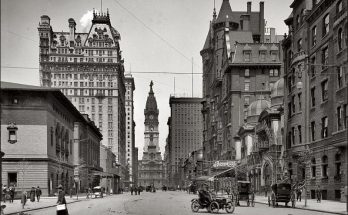
Meantime, as one result of the Haymarket tragedy, the Civic Federation was founded by Lyman C. Gage, a banker, to provide free and open discussion of controversial questions. In 1889 Jane Addams opened Hull House in the worst slum district on the West Side. By 1890 Chicago had more than 1,000,000 people, having added 200,000 the previous year by the annexation of several surrounding municipalities. The Newberry Library, and The Public Library, had been founded, and in 1892 the University of Chicago began with the most auspicious program in university history. Theodore Thomas had organized the Chicago Orchestral Association and had long been presenting the popular concert series that brought the city renown as a musical center. W. L. B. Jenny, Daniel H. Burnham, John W. Root, William Holabird, and other architects were constructing huge new buildings on steel frames and evolving a new architectural form. In Maitland Dictionary of American Slang, published in 1891, the new term “skyscraper” was defined as “a very tall building such as are now being built in Chicago.”

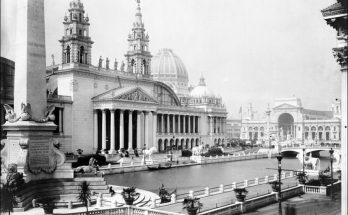
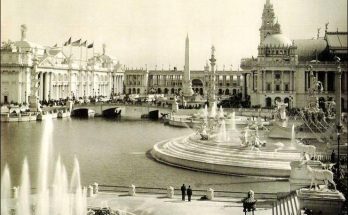
Commerce, manufacture, labor, and these new cultural developments united to bring the city one of its great triumphs, the World’s Columbian Exposition of 1893, in celebration of the 400th anniversary of the discovery of America. Jackson Park was developed out of swamp land on the South Side and here were built the great white buildings of the Fair in accordance with a master plan drawn by Daniel H. Burnham. The “White City,” as it was soon known on five continents, was hailed as the miracle of the day, the “miniature of an ideal city . . . built as a unit on a single architectural plan . . . a symbol of regeneration.” Millions crowded into the Fair to stare at and be equally impressed with “the most beautiful building since the Parthenon,” a knight on horseback made of California prunes, cannons by Krupp, the Tower of Light, and the Parliament of Religions–the whole providing “matter of study to fill 100 years.”