New Orleans

The Creole Food of New Orleans

The Creole food of New Orleans is unlike anything else in the country. It is here European visitors to US more often tan not find food to their liking, if indeed they ever do find any. New Orleans dishes bear little or no resemblance to those of any other part of United States. Somehow this style of food survives in the state of Louisiana, with its headquarters in New Orleans. For those to whom the early history of the United States is hazy, it may be appropriate to recall that France once owned and settled what is now Louisiana; the food, customs and language of France have survived to the present day. Good use is made of the locak seafood, including shrimp, crabs and oysters. This is the only place in the world where authentic gumbos, files, and jambalayas are to be had, although these dishes have spread throughout the Caribbean. There are about a half dozen famous restaurants in New Orleans where Creole food may be enjoyed in the perfection of fresh ingredients and authentic spices, prepared by cooks who know what to do with them.

A Table Spread with Fruit and Seafood Prepared in the Local Creole Way

A Table Spread with Fruit and Seafood Prepared in the Local Creole Way
Buy This Allposters.com

New Orleans What to See – French Quarter Art Print

New Orleans is in southeastern Louisiana, on the Mississippi River. It prides itself on being the ‘Most Interesting City in the United States’. Famous for its Creole cuisine and fine restaurants, its Old French Quarter, its nightclubs and ‘Dixiland Jazz’, the city’s character is a mixture of sophistication, honkytonk and Southern hospitality.

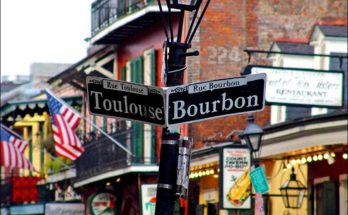
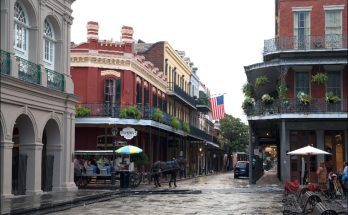
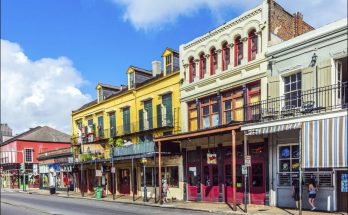
Undoubtedly the greatest attraction for tourists is the French Quarter, which still tetains much of its original appearance of 200 years ago. Streets are narrow, buildings have exquisite wroughtiron balconics and railings; there are patios and courtyards, and many historic spots. Bourbon Street is best at night; Royal Street has some delightful shops and opens onto lovely courtyards. The Louisiana Wildlife Museum on Royal houses an unusual collection of birds. See the Cabildo, erected in 1795, scene of the signing of the Louisiana Purchase; St Louis Cathedral; Pontalba Apartments, reputedly the first apartment house in the United States; Absinthe House, now a public bar and restaurant; the French Market. See the unusual old cemeteries in Cities of the Dead, with the highly decorated tombs of original settlers.

French Quarter

French Quarter
Buy This Allposters.com

Museums include Isaac Delgado Museum of Art (art exhibits); Institute of Middle American Research at Tulane University (Mayan collections); Louisiana State Museum, in the Cabildo; New Orleans Jazz Museum, 300 Bourbon Street.

See City Park, in the northern part of the city with three public golf courses, many amusements and recreational facilities. The famous Dueling Oaks, where affairs of honor were once settled, are also in City Park; Audubon Park, in the southwestern part, has a zoo and aquaium.

Travel Art: New Orleans French Quarter Art Print

French Quarter

French Quarter Art Print
Dynner, Lidia
30 in. x 24 in.
Buy at AllPosters.com
Framed   Mounted

New Orleans is in southeastern Louisiana, on the Mississipi River about 60 miles north of the Gulf of Mexico. New York City is 1,340 miles northeast, Miami 885 miles southeast and Los Angeles 1,920 miles west. The original settlement was founded by the Frencman Sieur de Bienville and named for the Duke of Orleans. In 1762, against the wishes of its French inhabtants, New Orleans was ceded to Spain. In 1803 it was retroceed to France and only twenty days later ceded to the United States under the terms of the Louisiana Purchase. The city’s strategic position has twice subjected it to military assault. In 1815, General Andrew Jackson successfully defended it against a British attack at the Battle of New orleans – the final engagement of the war of 1812. In 1862, the city, then a Confederate stronghold, was captured and occupied by Union forces. But its strategic position has also brought New Orleans prosperity and today it is the chief cotton market of the United States and one of the great ports of the world.

New Orleans prides itself on being the ‘Most Interesting City in the United States’ and the claim is not unjustified. Famous for its Creole cuisine and fine restaurants, its Vieux Carre (Old French Quarter), its night clubs and ‘dixieland jazz’ the city does have a great deal to offer the tourist. Its personality, easy to sense but difficult to describe – is a mixture of sophistication, ‘honky-tonk’ and Southern hospitality – all blended to make New Orleans the unique American city it is.

Most of the city’s commercial activity is concentrated near the foot of Canal street beginning at the Mississipi River front and running northwesterly. Industrial installations are scattered throughout the outlying areas of the city. Moisant International Airport is 11 miles northwest of the city. Travel time about 50 minutes.

new orleans, new orleans posters, united states posters, french quarter art prints, urban landscapes, travel art, travel art prints, travel destinations, cafe decoration, home decoration, lidia dynner art

New Orleans History: Americans Develop the City

new-orleans.jpg

After American annexation numerous Americans, aware of the fortunes to be made in a city so advantageously situated, began to settle in New Orleans. Because of the antipathy of the Creoles, who pictured all Americans as boorish rowdies, the newcomers settled in the Faubourg Ste. Marie on the upstream side of the town in what is now the business section of New Orleans. Here they developed a town quite distinct from the old New Orleans. As time passed and the city began to benefit from unrestricted trade with other States of the Mississippi Valley the two elements merged, and though the Creoles held themselves aloof socially, common civic interests and the leveling effect of commercial intercourse tended to unite the inhabitants.

New Orleans was incorporated February 17, 1805, and the city limits defined. The municipal government consisted of a mayor, a recorder, a treasurer, and fourteen aldermen. The latter formed a council whose function it was ‘to make and pass all by-laws and ordinances for the better government of the affairs of the city corporation.’ Free white males, residents of New Orleans for a year, either owners of real estate of five hundred dollars’ value or renters paying one hundred dollars a year, were qualified to vote. James Pitot, builder of one of the first cotton presses in New Orleans (corner of Toulouse and Burgundy Streets) succeeded Étienne de Boré as mayor, and on March 4, 1805, the townspeople first exercised their franchise in an election of aldermen.

In the same year the Legislature provided for the establishment of New Orleans’first higher institution of learning, the College of Orleans. Schools in the Colony had been scarce. The Ursuline nuns offered instructions to seventy or eighty young girls and maintained a schoolhouse near the convent where ‘female children appeared at certain hours to be gratuitously instructed in writing, reading, and arithmetic.’ No mention is made of similar schools for boys; they had to rely, possibly, upon private schools such as that conducted by the Reverend Philander Chase on Tchoupitoulas Street, or that opened at 29 Bienville Street by Francis Hacket, teacher of English, arithmetic, geography, and history. The College of Orleans, which was finally opened in 1811 through a government appropriation of $15,000, had a president and four professors and a curriculum which included Latin, Greek, English, French, Spanish, philosophy, literature, and the sciences. From 1822 to 1825 the college was under the direction of Joseph Lakanal, prominent for his work in reorganizing the French school system under the Directory and Napoleon.

The New Orleans Library Society was incorporated April 19, 1805, when an unlimited number of twenty-five-dollar shares were sold and the first library in New Orleans was established. During the same year, after a vote of the Protestants in the city favored an Episcopal clergyman, the first Protestant church was organized.

Many improvements were made in the town during the next few years. A waterworks carrying water from the Mississippi in wooden conduits laid a foot and a half below the banquettes was installed by Louis Gleise; a Negro chain gang was employed in filling in the streets; sidewalks were built and crossing bridges constructed; and meat markets, notoriously unclean, had their water closets torn down.

As the center of Aaron Burr’s filibustering schemes, New Orleans was thrown into a panic in the winter of 1806 when a large flotilla with Burr as its leader was reported descending the Mississippi to use the city as a base in furthering his intention of separating the Western country from the United States or, failing in that, to wrest Mexico from Spain. The banks were to be plundered of $2,000,000 and Louisiana revolutionized.

Great efforts were made to fortify the city against what was said to be a formidable force. The Chamber of Commerce met to consider ways and means of defense, money was subscribed, orders given for organization of the Battalion of Orleans, and volunteers and the militia cavalry ordered out. In the meantime, Burr with sixty to eighty men kept ahead of orders for his arrest until he was stopped at Natchez and held for trial, at news of which the hysteria in New Orleans subsided as quickly as it had been aroused.

The first steamboat to descend the Mississippi River arrived in New Orleans amid great enthusiasm on January 10, 1812. Propulsion by steam solved the problem of upstream navigation, and was the greatest single factor in the rapid growth of New Orleans to a major North American port.

Louisiana was admitted to the Union April 30, 1812. New Orleans, then the capital of the State, had a population of 24,552 in 1810, having more than doubled its population in the first decade of the nineteenth century. This increase was caused largely by the immigration of refugees from Santo Domingo; almost six thousand arrived in two months in 1809. The city, hard pressed at first to find room for the immigrants, absorbed them in the course of time. Gay and luxury-loving, they infused a new spirit into the town and tended to offset the American influence then beginning to be felt.

New Orleans Hotels Royal Sonesta Hotel, Hotel Maison De Ville, Windsor Court Hotel

Royal Sonesta Hotel New Orleans

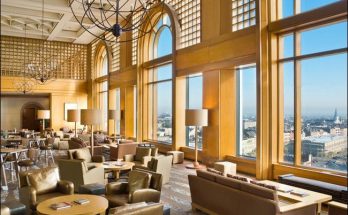
Distinctly European, unmistakably New Orleans. The decadent old South combined with distinguished European elegance: crystal chandeliers and lace iron balconies… stylish French doors and a lush hidden courtyard…uncompromising service and native cuisine… plus a French Quarter location that puts the pulse of New Orleans at your fingertips. Sonesta Hotel New Orleans: A Grand Hotel in the French Quarter

Hotel Maison De Ville

A historic hotel in the heart of the French Quarter. Nestled in its quintessential New Orleans setting, the Hotel Maison De Ville offers gracious accommodations and unsurpassed service. This summer indulge yourself and ask for Visa Gold “Summer Celebration.” You deserve it.

Windsor Court Hotel

Enjoy the hotel deemed “The Best” in 1988 and 1995. The legendary Grill Room, 324 luxurious rooms (including over 250 suites) and the finest in traditional hotel services… with the frenzy of the French Quarter just down the block.

The Homestead, Hot Springs, Va.

Selected in the top 10 golf resorts of the world, The Homestead offers three renowned courses including the nationally acclaimed Cascades, ranked as the third best non-private course in the U.S. You will also find 517 luxurious rooms, superb dining, hiking, mountain biking, fly fishing, canoeing, shooting sports, equestrian activities, tennis and, of course, a renowned European-style spa.

Galena, Illinois

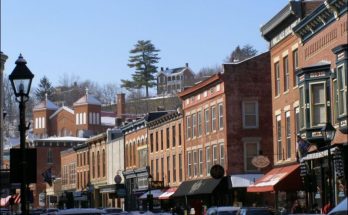
Galena

GALENA (603 alt., 3,460 pop.), in the extreme northwest corner of the State, perches on the terraces cut by the old Fever River, a novel sight to eyes accustomed to the prairie flatness. Its streets climb tortuously from level to level of the ancient river bed, and the houses cling to the hills like chalets in an Alpine village. Deserted warehouses and granaries line the old course of the river. On the middle slopes the church spires rise above masses of trees along winding cobbled roads; many steep flights of steps climb the bluffs; on the heights is the high school, the clock of which marks the time for the countryside. Typical of the long flights of steps that scale the bluffs are those between Main and Prospect Streets, leading to the high school. In the valley trickles the stream, now called the Galena River, which cut the terraces on which the city is built; its once strong current bore to Galena’s wharves the freight of the northwest, but Galena is now the ghost of a metropolis, the relic of the first major industrial development of the region.

The most vivid reminder of Galena’s past is its architecture. The diversity of background of Illinois’ pioneers brought about the great variety of styles in which they designed their houses and public buildings. Because of this diversity, Illinois has never developed a style distinctively its own, as have most of the eastern seaboard states. But in Galena survive more examples of good American building than perhaps anywhere else in Illinois, a résumé of the nation’s architectural experience. Along the terraces of Bench, Prospect, and High Streets, are stately Greek Revival mansions of brick, imposing in size and romantic in setting. On the scrambled byways the range runs from a Cape Cod cottage to a number of tiny Greek temples, both in the Doric order and in the Ionic. New Orleans galleries, colonnaded porticos, iron grilles from French foundries, the forthright gable ends of Pennsylvania, and the double galleries of the Carolinas, all are here. The Victorian era swept over Galena lightly, and the scourge of gingerbread brackets and scrolls so prevalent through newer sections of the State is less virulent here than elsewhere. In the main, the churches hark back to New England, an exception being the Grace Episcopal Church, in early English Gothic style, built of rough gray stone hewn from the hollow in the bluff in which the church is tucked away. The elegance of the De Soto House, a 200-room hotel built in 1855, was unparalleled in the State for many years.

The old air of opulent luxury has mellowed with time to a gentle and decorous decay. The great houses seldom blaze with the festive lights of other years, the once teeming streets are placid now, and the shouts of the roustabouts have long since been stilled on the wharves. Galena is now distinguished among its neighbors mainly by reason of its topography, and for the story of pioneer achievement still documented on its streets.

For more than half a century before the Revolutionary War, when such settlements as existed in the Illinois country were either missions or trading posts, the lead deposits of the Galena district, in what was then called the Fever River Valley, excited the ambition and avarice of the French adventurers. The existence of lead in what is now southern Wisconsin was probably known before the explorations of Marquette and Jolliet, who mentioned it in their reports. The Indians mined it, but were unfamiliar with its use, except as a medium of exchange with the whites. It was of such interest to France that a party of 30 men under Le Sueur and Iberville was sent out in 1699 to investigate. Le Sueur is credited with the discovery of the Galena River in August 1700. He called it the River of Mines, and it was so named on a map published in Paris in 1703 by Delisle, geographer of the French Academy of Sciences. The Galena district was included in John Law’s unfortunate promotion scheme of 1717, since known as the Mississippi Bubble. There are accounts of widespread prospecting by an expedition under Phillippe François de Renault in the second or third decade of the eighteenth century. This party, said to have numbered 200 miners and 500 slaves from Santo Domingo, was probably the largest group to come into the region up to that time, when the population of the Illinois country is given as 500. Perhaps some of these men remained and were joined by others, for in 1743 Le Guis wrote of finding along the Fever River 18 or 20 miners, whom he describes as a “fast lot.” Although there is little information concerning the next 75 or 80 years, the theory has been advanced that during that period soldiers and trappers of the Mississippi Valley used lead from the Galena district in the manufacture of their bullets.

After years of plundering by these freebooters, Congress passed a statute in 1807, which took the mines under government protection; mineral lands could be occupied and worked only on lease. The opening of steam transportation on the Mississippi River about 1816 spread the fame of the diggings through the land, and the subsequent 15 years saw the transition to a semblance of order. In 1826 the post office was established, the first in northern Illinois, and the town was laid out and named for the sulphide of lead for which the region was noted.

The peak of the Galena rush occurred in 1828 and 1829 when squatters swarmed into the region, and trading became concentrated at what is now Galena. The first lease under the new protective statute was granted in 1822, the first steamer entered the Fever River in 1823, and in the same year the first licensed smelter began operations. That first year’s output was 210 tons of metal; production rose rapidly to 27,000 tons in 1845, when Galena produced 83 per cent of the country’s supply, which made the town the unchallenged metropolis of the region. River traffic made Galena a trading center also. Many warehouses were built along the river; the retail and wholesale stores which filled the business district in the lowest level of the town were stocked with all the necessaries for every domestic and commercial undertaking. The early thirties saw the beginning of agricultural development, and granaries were built along the river. These granaries ingeniously solved the elevator problem, for wagons simply unloaded from streets level with the top stories into chutes that carried the grain to the water’s edge.

The people, largely drawn from Virginia and the South, brought with them the habits and standards of their slave-holding forebears. While other settlements were building log cabins, Galena was erecting the mansions of stone and brick which still mark a high level in America’s architectural development. While settlers in other regions were concerned primarily with the struggle for existence, Galena’s citizens were building churches and schools, founding a library, publishing the widely read Galena Gazette, forming societies for “moral and intellectual development,” and altogether living a life unmatched in the Middle Border.

This order of things was not to endure. After the prosperous days of the forties and fifties a gradual decline set in. Galena, like many boom towns, had enjoyed a prosperity based on factors as evanescent as they were brilliant. The lead in the surface veins was finally exhausted; the mines could no longer be operated at a profit. Her supremacy as a market center vanished with the completion of the railroad in 1855, for the road diverted traffic from the river and gave every village through which it passed an advantage equal to that of the city which had so vigorously promoted its construction. The river contributed to the downfall by silting in, and the heavily laden cargo boats of earlier days could no longer navigate the channel. The gold rush to California in 1849 drew off the more adventurous of the mining population, and the town turned slowly from the glamor of fortunes made and lost overnight to the slow processes of farming. The country as a whole fell on evil days with the panic of 1857, and Galena, which had survived an earlier panic untouched, suffered seriously under the national calamity.

With the outbreak of the feeling which led to the Civil War, Galena was divided in its political faith. A large proportion of its citizenry being of Southern origin, it had been definitely a slave-holding community until the adoption of the State Constitution of 1848 put a ban on the ownership and sale of human lives. If the decline of river traffic had not loosened the town’s bonds with the South, the situation would have been even more critical. President Lincoln’s appeal for troops after the fall of Fort Sumter brought a local crisis; considerable wrangling ensued, but those who favored the Union prevailed, and two companies were formed to support the President.

Ulysses S. Grant, a veteran of the Mexican War, had recently come to Galena from St. Louis. Grant declined the captaincy of one of the Galena companies, but consented to act as drillmaster, and accompanied the troops to Springfield. Six weeks later he was commissioned colonel of the 21st Illinois Volunteers; in August 1861, he was appointed brigadier general. As he came from a State with marked Southern sympathies, his appointment was questioned, but finally confirmed through the influence of his friend, Congressman Washburne.

He rewarded his supporters by appointing eleven of them to high commands in the Union forces, the town’s roster of generals surpassing that of any comparable community in the country. Galena’s hero eventually led the Federal armies, and brought the town greater glory when he was elected to the Presidency.

Since those days Galena has changed little in appearance. Modern fronts screen 80- and 100-year-old stores; creameries and a cheese factory have replaced the lead smelters; several small manufacturing plants maintain the industrial tradition. But to the visitor Galena is primarily a symbol of life of a century ago when it was a cultural and commercial capital of the old Northwest.