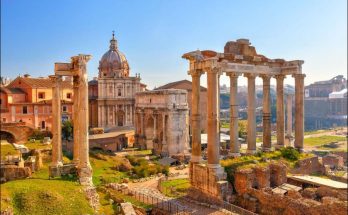
Roman Forum

Rome: The Roman Forum

Roman Forum, Rome, Italy

Roman Forum, Rome, Italy Photographic Print
Panoramic Images
24 in. x 8 in.
Buy at AllPosters.com
Framed   Mounted

‘I need no ivory temple for my delight,’ wrote Propertius in Augustus’ day, ‘enough that I can see the Roman Forum.’ Here, from immemorial times, had been the meeting place of a civilization that was always positive. This Forum, so quiet in its ruins now, was filled with activity from the dawn of recorded history. Around its edges butchers, fruit-sellers, and money-lenders had their stands; in its centre were held public meetings and religious ceremonies closely bound up with the city’s practical life. If the past haunts the Forum, it is a past filled with less sinister figures than those which linger in the shadows of the Palatine above.

Nowhere in Rome has more human drama been crowded into so little space. Here, according to tradition, the men of Romulus had snatched as brides the maidens of the Sabine tribes. Here, too, was set the tragic, stirring tale of the centurion Virginius, and his daughter, Virginia, whom he stabbed with a knife from a nearby butcher’s shop to save her from a tyrant’s claim. Here legend placed the ancient story of Marcus Curtius’ leap into the unfathomable gulf yawning below the Capitol. Here Antony showed the Romans the body of the murdered Caesar and read them his will. Here, too, roused to fury by this sight and by the dead Caesar’s generosity, the people burned his body in their most honoured spot as a final tribute to his memory. And along the Forum’s Sacred Way, from the Arch of Titus up the Capitol hill, passed the triumphal processions of emperors and generals, returning victorious from the wars.

The Forum’s activities probably took place at first entirely in the open air. Later shops and temples were built and the great basilicas along the edges, which combined halls for courts and assemblies with space for shops. Throngs too large for these basilicas were addressed from the rostra, special platforms built for this purpose, or from the steps of the Forum’s temples. The Senate met in these temples, as well as in others throughout Rome, but its special home was in the Forum, in the Senate House, consecrated to Victory.

Julius Caesar, city planner as well as warrior and statesman, gave the Forum the general shape it preserves today. One of the most arresting spots in its whole area is the altar before the temple dedicated there by the Senate to mark the place where his body was burned in 44 B.C.

As power grew more and more concentrated in the hands of the emperors and their officials, public activities in the Forum became less important. But the place remained as unique in Roman memory as when Cicero had called it ‘the Forum in which all justice is preserved’. The emperors built larger and more elaborate forums for business and amusement, but this remained ‘the Forum’ or ‘the Forum of the Romans’, by virtue of its age and associations.

View Across the Roman Forum, Rome, Lazio, Italy, Europe

View Across the Roman Forum, Rome, Lazio, Italy, Europe Photographic Print
Miller, John
12 in. x 9 in.
Buy at AllPosters.com
Framed   Mounted

As Christianity gradually conquered paganism, the temples of the Forum were closed by imperial edicts, though these edicts were disregarded from time to time. For a while some of the temples were safeguarded as public monuments or kept for various uses. But the Gothic wars of the sixth century so drained the city’s resources that it would have been impossible to keep the old buildings in good repair, even had any considerable group wanted to preserve the remnants of paganism. The temples which survived did so largely because they were transformed into churches or because they were too massive to be pulled down easily for building material. The earthquake of 847, which damaged the Colosseum, probably hastened their destruction.

(more…)

Terme Di Caracalla – Baths of Caracalla

Open air opera at Baths of Caracalla, in Rome, is one of the great summer events of Europe. The opera stage is set amid the gigantic ruins of the former Roman bath house, and the setting is spectacular-for certain productions, the ruins are actually employed as part of the scenery. Performances are scheduled almost nightly, the latter being perfectly satisfactory. Try, of course, to get to any of the performances, but if a production of “Aida” is scheduled, then rise from a sick bed to be attendance, because you’ll see a spectacle that’s equalled by no other opera company. A near-army of extras fills the stage during the triumphal march of the second act, and an elephant or else a brace of horses comes charging in at the climax. With all this, the voices may seem overlooked, but the overall effect is stupefying.

For summer concerts in Rome, you’ll want to be at the periodic recitals of the renowned Santa Cecilia Orchestra, performed at the Basilica of Massenzio (entrance on the Via de Fori Imperiale, with the background setting being the Roman Forum). But take nothing better than some Euros seats-only the crowd from the Hotel Excelsior goes for higher-priced variety.