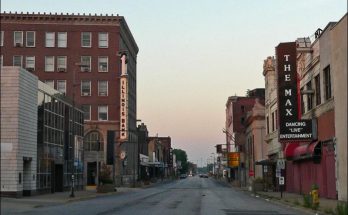
Illinois

Galena, Illinois

Galena

GALENA (603 alt., 3,460 pop.), in the extreme northwest corner of the State, perches on the terraces cut by the old Fever River, a novel sight to eyes accustomed to the prairie flatness. Its streets climb tortuously from level to level of the ancient river bed, and the houses cling to the hills like chalets in an Alpine village. Deserted warehouses and granaries line the old course of the river. On the middle slopes the church spires rise above masses of trees along winding cobbled roads; many steep flights of steps climb the bluffs; on the heights is the high school, the clock of which marks the time for the countryside. Typical of the long flights of steps that scale the bluffs are those between Main and Prospect Streets, leading to the high school. In the valley trickles the stream, now called the Galena River, which cut the terraces on which the city is built; its once strong current bore to Galena’s wharves the freight of the northwest, but Galena is now the ghost of a metropolis, the relic of the first major industrial development of the region.

The most vivid reminder of Galena’s past is its architecture. The diversity of background of Illinois’ pioneers brought about the great variety of styles in which they designed their houses and public buildings. Because of this diversity, Illinois has never developed a style distinctively its own, as have most of the eastern seaboard states. But in Galena survive more examples of good American building than perhaps anywhere else in Illinois, a résumé of the nation’s architectural experience. Along the terraces of Bench, Prospect, and High Streets, are stately Greek Revival mansions of brick, imposing in size and romantic in setting. On the scrambled byways the range runs from a Cape Cod cottage to a number of tiny Greek temples, both in the Doric order and in the Ionic. New Orleans galleries, colonnaded porticos, iron grilles from French foundries, the forthright gable ends of Pennsylvania, and the double galleries of the Carolinas, all are here. The Victorian era swept over Galena lightly, and the scourge of gingerbread brackets and scrolls so prevalent through newer sections of the State is less virulent here than elsewhere. In the main, the churches hark back to New England, an exception being the Grace Episcopal Church, in early English Gothic style, built of rough gray stone hewn from the hollow in the bluff in which the church is tucked away. The elegance of the De Soto House, a 200-room hotel built in 1855, was unparalleled in the State for many years.

The old air of opulent luxury has mellowed with time to a gentle and decorous decay. The great houses seldom blaze with the festive lights of other years, the once teeming streets are placid now, and the shouts of the roustabouts have long since been stilled on the wharves. Galena is now distinguished among its neighbors mainly by reason of its topography, and for the story of pioneer achievement still documented on its streets.

For more than half a century before the Revolutionary War, when such settlements as existed in the Illinois country were either missions or trading posts, the lead deposits of the Galena district, in what was then called the Fever River Valley, excited the ambition and avarice of the French adventurers. The existence of lead in what is now southern Wisconsin was probably known before the explorations of Marquette and Jolliet, who mentioned it in their reports. The Indians mined it, but were unfamiliar with its use, except as a medium of exchange with the whites. It was of such interest to France that a party of 30 men under Le Sueur and Iberville was sent out in 1699 to investigate. Le Sueur is credited with the discovery of the Galena River in August 1700. He called it the River of Mines, and it was so named on a map published in Paris in 1703 by Delisle, geographer of the French Academy of Sciences. The Galena district was included in John Law’s unfortunate promotion scheme of 1717, since known as the Mississippi Bubble. There are accounts of widespread prospecting by an expedition under Phillippe François de Renault in the second or third decade of the eighteenth century. This party, said to have numbered 200 miners and 500 slaves from Santo Domingo, was probably the largest group to come into the region up to that time, when the population of the Illinois country is given as 500. Perhaps some of these men remained and were joined by others, for in 1743 Le Guis wrote of finding along the Fever River 18 or 20 miners, whom he describes as a “fast lot.” Although there is little information concerning the next 75 or 80 years, the theory has been advanced that during that period soldiers and trappers of the Mississippi Valley used lead from the Galena district in the manufacture of their bullets.

After years of plundering by these freebooters, Congress passed a statute in 1807, which took the mines under government protection; mineral lands could be occupied and worked only on lease. The opening of steam transportation on the Mississippi River about 1816 spread the fame of the diggings through the land, and the subsequent 15 years saw the transition to a semblance of order. In 1826 the post office was established, the first in northern Illinois, and the town was laid out and named for the sulphide of lead for which the region was noted.

The peak of the Galena rush occurred in 1828 and 1829 when squatters swarmed into the region, and trading became concentrated at what is now Galena. The first lease under the new protective statute was granted in 1822, the first steamer entered the Fever River in 1823, and in the same year the first licensed smelter began operations. That first year’s output was 210 tons of metal; production rose rapidly to 27,000 tons in 1845, when Galena produced 83 per cent of the country’s supply, which made the town the unchallenged metropolis of the region. River traffic made Galena a trading center also. Many warehouses were built along the river; the retail and wholesale stores which filled the business district in the lowest level of the town were stocked with all the necessaries for every domestic and commercial undertaking. The early thirties saw the beginning of agricultural development, and granaries were built along the river. These granaries ingeniously solved the elevator problem, for wagons simply unloaded from streets level with the top stories into chutes that carried the grain to the water’s edge.

The people, largely drawn from Virginia and the South, brought with them the habits and standards of their slave-holding forebears. While other settlements were building log cabins, Galena was erecting the mansions of stone and brick which still mark a high level in America’s architectural development. While settlers in other regions were concerned primarily with the struggle for existence, Galena’s citizens were building churches and schools, founding a library, publishing the widely read Galena Gazette, forming societies for “moral and intellectual development,” and altogether living a life unmatched in the Middle Border.

This order of things was not to endure. After the prosperous days of the forties and fifties a gradual decline set in. Galena, like many boom towns, had enjoyed a prosperity based on factors as evanescent as they were brilliant. The lead in the surface veins was finally exhausted; the mines could no longer be operated at a profit. Her supremacy as a market center vanished with the completion of the railroad in 1855, for the road diverted traffic from the river and gave every village through which it passed an advantage equal to that of the city which had so vigorously promoted its construction. The river contributed to the downfall by silting in, and the heavily laden cargo boats of earlier days could no longer navigate the channel. The gold rush to California in 1849 drew off the more adventurous of the mining population, and the town turned slowly from the glamor of fortunes made and lost overnight to the slow processes of farming. The country as a whole fell on evil days with the panic of 1857, and Galena, which had survived an earlier panic untouched, suffered seriously under the national calamity.

With the outbreak of the feeling which led to the Civil War, Galena was divided in its political faith. A large proportion of its citizenry being of Southern origin, it had been definitely a slave-holding community until the adoption of the State Constitution of 1848 put a ban on the ownership and sale of human lives. If the decline of river traffic had not loosened the town’s bonds with the South, the situation would have been even more critical. President Lincoln’s appeal for troops after the fall of Fort Sumter brought a local crisis; considerable wrangling ensued, but those who favored the Union prevailed, and two companies were formed to support the President.

Ulysses S. Grant, a veteran of the Mexican War, had recently come to Galena from St. Louis. Grant declined the captaincy of one of the Galena companies, but consented to act as drillmaster, and accompanied the troops to Springfield. Six weeks later he was commissioned colonel of the 21st Illinois Volunteers; in August 1861, he was appointed brigadier general. As he came from a State with marked Southern sympathies, his appointment was questioned, but finally confirmed through the influence of his friend, Congressman Washburne.

He rewarded his supporters by appointing eleven of them to high commands in the Union forces, the town’s roster of generals surpassing that of any comparable community in the country. Galena’s hero eventually led the Federal armies, and brought the town greater glory when he was elected to the Presidency.

Since those days Galena has changed little in appearance. Modern fronts screen 80- and 100-year-old stores; creameries and a cheese factory have replaced the lead smelters; several small manufacturing plants maintain the industrial tradition. But to the visitor Galena is primarily a symbol of life of a century ago when it was a cultural and commercial capital of the old Northwest.

East St. Louis, Illinois

east-st-louis.jpg

EAST ST. LOUIS (418 alt., 31,542 pop.), railroad and industrial center, lies opposite St. Louis, Mo., on the Mississippi flood plain known as the American Bottom. Steep bluffs rise several miles east, but within the city there are neither hills nor valleys. Warehouses and railroad yards crowd the riverfront. At the northwest is one of the
country’s largest stockyards, its borders outlined by huge packing plants. Mills manufacturing iron, steel, glass, aluminum, and some sixty other products sprawl through the south length of the city. Lusty, smoky, and virile, East St. Louis takes more pride in its industries than in any other phase of its civic life.

To thwart overflows that did frequent damage before a system of levees was installed, the main streets were graded from eight to fifteen feet above the flood plain. This accounts for the present pockmarked appearance of the business district, centered at Missouri and Collinsville Avenues. Vacant lots along side streets resemble shallow quarry pits and the roofs of houses that antedate elevation of the streets are but a few feet higher than the pavement. Elsewhere, the streets are built on the ground level, and house foundations are of ordinary height.

Missouri Avenue, from 10th Street southeast to its terminus, is the division point between the Negro and white residential sections. For the most part, the latter lie north of this avenue beyond the area of heavy industry. Architectural styles range from houses of the late 1880′s, with mansard roofs, to scores of brick “flats” of pre-World War and contemporary construction. Outnumbering these are conventional frame or brick structures, with gable roofs and wide front porches. The Lansdowne section near Jones Park is beautifully landscaped, but scarcely less attractive is the Alhambra Court neighborhood at 35th and State Streets. The latter street is the main thoroughfare of the white residential area, its four-mile length lined with chain stores, restaurants, filling stations, and automobile repair shops.

Most of the city south of Missouri Avenue and 10th Street, excepting the Alta Sita region on Bond Avenue southeast of 21st Street, is occupied by Negroes, who comprise 15.5 per cent of the population. Negroes have their own schools, churches, grocery stores, and motion picture theaters. Industrial plants have begrimed the section; its sole strip of green is Lincoln Park, 16th Street and Piggott Avenue. An intermixed Negro and foreign born population lives in the “Bad Lands” along Missouri Avenue, between 21st and 31st Streets, while the remnant of a once-sizeable Armenian colony dwells near 16th Street and Broadway.

The farms on the bluffs and bottom land around East St. Louis produce abundant crops almost within the shadow of the industrial plants. At dusk during the harvest season hundreds of trucks laden with corn and vegetables file across the Municipal Bridge to the curb markets of St. Louis. In autumn the farmers’ trucks give way to larger vehicles piled high with coal from the mines of southern Illinois. These caravans enliven the city’s aspect, but add little to its income. Of much greater consequence are the freight trains that rumble in at all hours, carrying livestock from the West and goods from the East.

Chicago’s History 1800s

chicago-1930s.jpg

Times were indeed lush at the tip of the lake. Typical of the almost Hollywoodian order of things in that period was the case of the bankrupt backwoods tailor who came to Chicago, sold trousers for a few years, and built one of the largest and most celebrated hostelries of its day. Race tracks, gambling saloons, and bawdy houses multiplied. Lavish “marble” mansions went up along Michigan Avenue to 12th Street. Theaters, hotels, shops, and business buildings crowded into what is now the Loop. Coal yards, warehouses, flour mills, factories, foundries, and distilleries lined the river banks and the lake front. Scattered through the city were 170 churches–25 Catholic, 21 Methodist, 19 Presbyterian, and 5 Jewish, a partial reflection of the fact that half the Chicagoans of that day were foreign-born.

In 1867, after years of violent protest that the entire community was being poisoned by “filthy slush, miscalled water . . . a nauseous chowder” of fish and filth, which was taken from the lake into which the city poured its sewage, a sanitary water system was installed and immediately reduced the appallingly high death rate. The flow of “Garlic Creek” was reversed in 1871, and some of its foul waters were carried down the Illinois into the Mississippi, but not in sufficient quantity, so that sewage continued to pour into the river and the lake, to be thrown back at Chicago by the winds and waves.

Public high schools and evening schools, industrial and professional schools, including one of the first art schools in the country, two colleges, three theological seminaries, the Chicago Historical Society, and the Academy of Sciences were established in this period. In 1869 a ring of unimproved parks with boulevard connections surrounded the “Garden City.” Beyond, in suburban subdivisions, carpenters were hammering out miles of houses that were to be swallowed in the city’s growth within two decades. “More astonishing than the wildest vision of the most vagrant imagination!” visitors exclaimed, and Chicagoans agreed, although they felt that a more accurate index of the city’s superiority over all others was provided when the White Stockings, its professional baseball team, defeated the Memphis nine, 157 to 1.

But, born in the haste to put wall and roof around home and business as quickly and cheaply as possible, a large part of the city’s construction ran to “shams and shingles.” Of the estimated 40,000 Chicago buildings in 1868, more than seven-eights were wooden. In 1871 the total increased 50 per cent, and while the 40 new stone buildings on State Street and many brick and iron-front structures elsewhere were promising improvements, solid blocks knew nothing but flimsy pine.

After months of severe drought a fire of unknown origin started in such a block, in a cow barn behind the cottage of Patrick O’Leary on DeKoven Street, Sunday night, October 8th, 1871. It soon spread beyond the control of the firemen, who were wearied by fighting and celebrating the defeat of a blaze that burned four blocks the previous day. A powerful wind swept flames to the north and northeast and hurled brands in advance of the roaring columns of fire, which destroyed the notorious “Conley’s Patch” and practically everything north of Van Buren Street in the areas now designated as the Downtown District and the Near North Side. So intense were the flames that hot blasts were felt in Holland, Michigan, 100 miles across the lake. Tapering to a point near the lake at Fullerton Avenue, the boundary with the then suburban Lake View, the fire stopped after consuming 17,450 buildings in 27 hours. At least 250 persons perished. Homes of one-third the population, about 1,600 stores, 60 manufacturing establishments and 28 hotels, railroad structures, government and other public buildings, and bridges became three and one-third square miles of ashes and debris. Thousands were penniless, stripped of their last possession.

The embers were scarcely cool before rebuilding began. Generous contributions of money and supplies came from the entire country and from Europe. Thousands of temporary structures provided for immediate needs while more than 100,000 artisans were reconstructing the city under stricter construction codes, although the latter were frequently violated. Extensions of credit and payment of about half of the $88,634,022 insurance on the $192,000,000 loss helped rebuild the business district within a year. In another two, scarcely a scar of the fire remained anywhere. Many buildings, particularly hotels and depots, were replaced by far costlier structures. Fashion took over Michigan Avenue south of 12th Street, and Prairie Avenue, and brought in granite and brownstone. Chicago dumped its debris within the lake breakwater, forming subsoil for a future park, and went about its increasing business. Local manufactures doubled between 1870 and 1873; Chicago banks, alone of those in the larger cities, continued steadily to pay out current funds during the acute financial panic of 1873.

The germ of American industrialism found the Chicago of the middle seventies an ideal medium. A circle of 500 miles contained the principal ingredients. Around western Lake Superior lay one-fifth of the world’s richest iron-ore reserve, yielding at the slightest scratch, easily loaded on lake freighters after a short land haul, and carried away by the most economical form of transportation on the continent. In Illinois, Indiana, Kentucky, West Virginia, and Pennsylvania, Chicago’s railroads clutched at a trillion tons of coal. Blast furnaces and large factories forged tremendous wealth that filled Prairie Avenue and spread into Lake Shore Drive.

Nationwide labor unrest, following the wave of western settlement that had “broken against the and plains” became particularly acute here. The line between wealth and poverty, cutting sharply into a single generation of workmen with rapidity unequalled elsewhere, drew Chicago into the forefront of “radical” cities. In 1877, led by Albert R. Parsons, workers in the factories and on the railroads struck for increased wages and the 8-hour day. Federal troops broke the strike, but without removing the causes of discontent. Industrial warfare over wages and hours grew increasingly bitter and culminated in the Haymarket bombing of 1886. Although no adequate evidence was produced that they had thrown the bomb, Parsons and three other labor leaders were hanged for the crime. Two others escaped death by having their sentences commuted to life imprisonment, and a third received a sentence of 15 years in prison. These three were pardoned seven years later by Governor John P. Altgeld, “. . . eagle forgotten” in Vachel Lindsay’s phrase, who denounced the trials as unfair and illegal and was himself denounced as little better than a criminal for daring to doubt highly questionable evidence. Again large strikes broke out in the depression years that followed 1893, notably that which began in the local Pullman shops and spread to the railroads; once more Federal troops broke the strike.

Meantime, as one result of the Haymarket tragedy, the Civic Federation was founded by Lyman C. Gage, a banker, to provide free and open discussion of controversial questions. In 1889 Jane Addams opened Hull House in the worst slum district on the West Side. By 1890 Chicago had more than 1,000,000 people, having added 200,000 the previous year by the annexation of several surrounding municipalities. The Newberry Library, and The Public Library, had been founded, and in 1892 the University of Chicago began with the most auspicious program in university history. Theodore Thomas had organized the Chicago Orchestral Association and had long been presenting the popular concert series that brought the city renown as a musical center. W. L. B. Jenny, Daniel H. Burnham, John W. Root, William Holabird, and other architects were constructing huge new buildings on steel frames and evolving a new architectural form. In Maitland Dictionary of American Slang, published in 1891, the new term “skyscraper” was defined as “a very tall building such as are now being built in Chicago.”

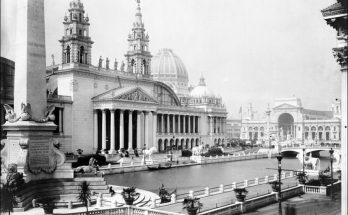
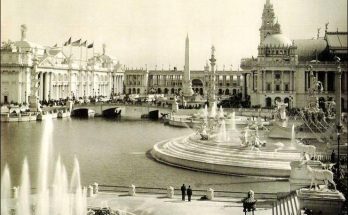
Commerce, manufacture, labor, and these new cultural developments united to bring the city one of its great triumphs, the World’s Columbian Exposition of 1893, in celebration of the 400th anniversary of the discovery of America. Jackson Park was developed out of swamp land on the South Side and here were built the great white buildings of the Fair in accordance with a master plan drawn by Daniel H. Burnham. The “White City,” as it was soon known on five continents, was hailed as the miracle of the day, the “miniature of an ideal city . . . built as a unit on a single architectural plan . . . a symbol of regeneration.” Millions crowded into the Fair to stare at and be equally impressed with “the most beautiful building since the Parthenon,” a knight on horseback made of California prunes, cannons by Krupp, the Tower of Light, and the Parliament of Religions–the whole providing “matter of study to fill 100 years.”

Cairo, southernmost city of Illinois and seat of Alexander County

cairo-ill.jpg

CAIRO (315 alt., 3,632 pop.), southernmost city of Illinois and seat of Alexander County, stands on the tip of a narrow peninsula where the Ohio pours its gray waters into the yellow Mississippi. Somewhat exotic for Illinois are Cairo’s ginkgo and magnolia trees, its nearby canebrakes and cottonfields. Many Illinoisans and others blink on learning that the city is farther south than Richmond, Virginia, or Tunis, Africa.

Cairo is encircled by a huge levee that rises from the river delta like the ramparts of a walled town. Steamboats have whistled for a landing on the Ohio side since the 1840′s. But most of the whistles have been stilled by the railroad, and today the levee, its revetted slope scoured clean by the river, has no more than a half-dozen sternwheelers moored along its mile-length. The street fronting the levee is lined with hotels, shops, and taverns, many of them deserted and falling to ruin, their weathered façades embellished with bracketed cornices, rows of dentils, and balconies of wrought iron. Of this quiet street, in which grass now sprouts between its pavement bricks, the Cairo Gazette reported in 1863: “Every house, cellar, and shed is occupied as a place of business and every occupant is doing well.”

The population of Cairo has declined from a 1920 high of 15,203 to 3,632 in 2000. Cairo today faces many significant socio-economic challenges, including poverty, education, and employment.

The first attempt at settlement here occurred in 1818 when John G. Comegys, a St. Louis merchant, obtained from the Territorial Legislature an act incorporating the city and the bank of Cairo. The projected city was so named because its site was presumed to resemble that of Cairo, Egypt. When Comegys died about 1820, his scheme perished with him, but he had made a lasting contribution to Illinoisana in his choice of the name Cairo, for as a result “Egypt” has become the popular name of southern Illinois.

A second and successful attempt at settlement began in 1837 when the State legislature incorporated the Cairo City and Canal Company, with Darius B. Holbrook, “a shrewd Boston Yankee,” as president. Holbrook hired several hundred workmen to build a levee, shops, and houses. The settlement was widely advertised in England, where the bonds of the Cairo City and Canal Company found eager purchasers through the London firm of John Wright & Company. This latter concern failed on November 23, 1840, and Cairo immediately declined, its population dropping from a thousand to less than a hundred within two years. Those who remained conducted shops and taverns for steamboat travelers. Charles Dickens visited Cairo on April 9, 1842; several historians have suggested that his interest in the settlement was inspired by his unprofitable investments in Cairo City bonds, but this is not established. In any case, he damned Cairo vigorously in American Notes ( 1842), using it as the prototype of the nightmare City of Eden in Martin Chuzzlewit ( 1843).

The discredited Cairo City and Canal Company was reorganized as the Cairo City Property Trust in 1846. Plans were laid to make Cairo the main depot of a trade route running south to the Gulf by water and north to the Great Lakes by rail. This necessitated the construction of a railway through Illinois, the cost of which was to be defrayed by a Federal land grant. In response to pressure generated by the Cairo City Property Trust, Congress gave Illinois more than 2,000,000 acres of public land in September 1850. The Illinois Central Railroad Company, beneficiary of the grant, was incorporated in 1851, and four years later a track between Cairo and Chicago was opened to traffic.

Cairo took root at once and prospered; its population had increased to 1,756 by 1857, the year in which a city charter was obtained. Each succeeding month increased the volume of products transported along the north-south route. This route might have become part of the basic economic pattern of the Middle West, with Cairo as a commercial capital, had not the Civil War dammed up the developing trade route. When gunboats drove the packets from the lower Mississippi, the corn and pork of central Illinois began to move in increasing amounts to Chicago, as they have continued to do, and Cairo ultimately ceased to be of importance as a regional commercial center.

Throughout the war Cairo was a concentration point of the Union Army and the base of the Western Flotilla, later renamed the Mississippi Squadron. One week after the fall of Fort Sumter, Cairo was garrisoned by 2,000 Illinois volunteers to prevent its seizure by Confederate troops, who had advanced within twenty miles of the city. The point at the junction of the rivers was fortified as Camp Defiance. Anthony Trollope, the English author, who visited Cairo in the winter of 1862, later reported in North America that the “sheds of soldiers” at Camp Defiance were “bad, comfortless, damp, and cold,” but that they did not “stink like those of Benton barracks at St. Louis.”

Ulysses S. Grant, then commander of the district of southeastern Missouri, established his headquarters at Cairo in September 1861. Here he massed men and gunboats for an arrow-like offensive that began early in February 1862, and resulted in the capture of Fort Henry, February 6, and Fort Donelson, February 16. Fourteen thousand Confederates were transported to Cairo to await confinement in Northern prisons. Later, when Vicksburg fell, some 30,000 Confederates were brought here.

By the end of the war Cairo had an estimated population of 8,000. In 1867 more than 3,700 steamboats docked at the city, a figure that made predictions about the decline of the steamboat seem absurd. Later, when the supremacy of the railroad was established, Cairo offset the loss in part by developing local plants to process cottonseed oil and mill lumber. In the last quarter of the century seven railroads were built into the city. Mark Twain, most notable of the steamboatmen who had gone “booming down to Cairo,” observed in Life on the Mississippi ( 1883) that “Cairo is a brisk town now and is substantially built and has a city look about it . . .”